Important notice
The Government of Alberta owns and operates Springbank Off-stream Reservoir. We have closed the dry reservoir area, in accordance with the land-use plan, for at least 2 growing seasons to allow land and vegetation to recover from construction. This also provides us time to restore disturbed sites and gives wildlife time to adjust to the landscape changes.
During this closure period, our staff and others will continue monitoring and maintaining the area.
How it works
Watch this video showing how the reservoir works.
During a flood, a diversion channel will carry water from the Elbow River to the off-stream reservoir. It has a storage capacity of 70.2 million cubic metres, or about 28,000 Olympic-sized swimming pools. When peak waters have passed, an outlet structure will safely release the water back to the Elbow River in a controlled manner.
The Springbank Off-stream Reservoir (SR1) will work together with the Glenmore Reservoir, which has 10 million cubic metres of available flood storage, to achieve the level of protection required.
Location
SR1 is about 15 km west of Calgary, which allows for:
- the capture of water from a large area of the basin, offering flood risk reduction to the City of Calgary and Rocky View County properties that are downstream, along the Elbow River
- a low-profile diversion structure that has lower impact on fish passage than conventional in-stream dams
- close proximity to operational response teams and access roads
What it looks like
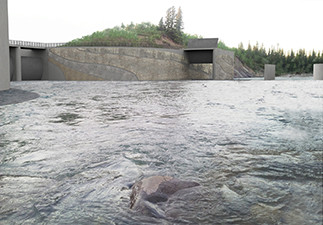
A diversion structure, with several components that work together, controls the amount of flood water that enters the diversion channel.
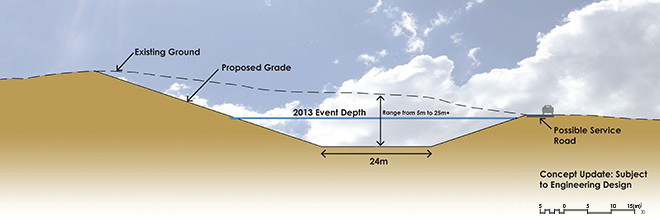
The diversion channel carries flood waters to the storage reservoir. The channel is about 4.5 km long with a bottom width of 24 metres.
The channel cut is similar to an irrigation canal with side slopes of about 3:1 (horizontal:vertical). It will generally be vegetated with native species. Erosion protection may be provided at select locations where faster water is anticipated.
Area needed
The total area within the project perimeter is approximately 3,870 acres, including road allowances, structures and the maximum extent of any backwater during emergency scenarios.
This perimeter also includes surplus borders around the various components of the infrastructure that may or may not be required as the precise location of the components is defined through additional engineering assessment and design.
The reservoir's full supply level is achieved when it is storing the 2013 flood event (water elevation 1,210.5 metres, based on current conceptual design). Based on the current dam location, this flooded area would be approximately 1,950 acres.
Background
In October 2015, government announced it would move forward with the Springbank Project, combined with upstream local flood mitigation, to reduce the impact of flooding on the Elbow River.
Choosing the Springbank Project
In June 2015, the Alberta government commissioned the Dutch research foundation, Deltares, to review the original infrastructure proposal reports and a subsequent benefit/cost study for flood mitigation work on the Elbow River and provide a recommendation on which project to take forward to construction-ready status.
SR1 and upstream local mitigation were chosen over the McLean Creek Dam because:
- the Springbank option was less costly
- has less environmental impact
- has shorter timelines
- will capture more runoff due to the SR1’s location further downstream
The Springbank option is also:
- closer to operational response teams and access roads
- less vulnerable to damage during extreme weather events
- less sensitive to impacts from sediment and debris
- more environmentally friendly than other options
- faster to construct and less likely to be negatively impacted by weather-related delays or risk of catastrophic failure
Reports
- Review of Bragg Creek/Springbank Off-stream Reservoir and McLean Creek Storage
- Recommendations on the Elbow River Major Infrastructure Decisions
Engagement
Stakeholders and Indigenous groups submitted their concerns to the project team, including questions related to:
- benefits and costs
- land use
- Indigenous consultation
- water and hydrogeology
- environmental impacts
Contact
Connect with the Springbank Off-stream Reservoir Project:
Email: [email protected]