Overview
Channel migration refers to the naturally occurring process where the main channel of a river, stream, or creek moves laterally within its floodplain over time.
Channel migration poses unique hazards that may result in risk to life, property, and the environment. Understanding and identifying channel migration hazards helps ensure Albertans and Alberta’s infrastructure are as safe as possible from ongoing or rapid flooding events.
Alberta’s government manages the production of channel migrations studies and maps to help Albertans and affected communities understand channel migration processes and identify channel migration zones to anticipate potential hazards.

Image 1. Ongoing changes in a section of the Freeman River in Woodlands County.
Channel migration terms
Erosion
The process where flowing water in a river, stream or creek wears away its bed and banks, carrying away sediments (for example: rocks, sand, and soil) and other materials.
Sediment transport
The process of movement of solid particles by flowing water. Rivers, streams or creeks transport sediments as bedload (coarse material dragged along the bottom), suspended load (fine particles held in the water), and dissolved load (chemicals dissolved in the water).
Deposition
The process where fast moving water slows down due to change in bed slope and can no longer carry the sediments. As a result, sediments are added to a landform or landmass (for example: floodplains, bars, in-channel islands, deltas).
Channel processes and their impacts
-
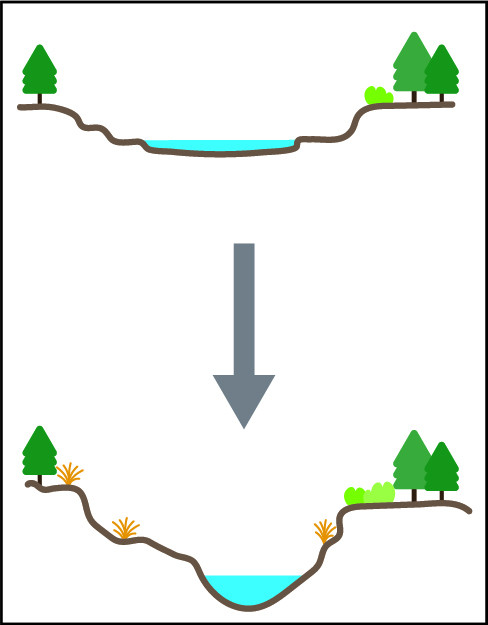 Channel incision
The process where a river, stream or creek deepens due to the erosion and transportation of bed materials downstream, and can result in steep bank walls.
-
 Channel expansion
Widening of a river, stream or creek due to the erosion and transportation of bank materials downstream. Channel expansion can occur because of processes like channel incision or land use change.
-
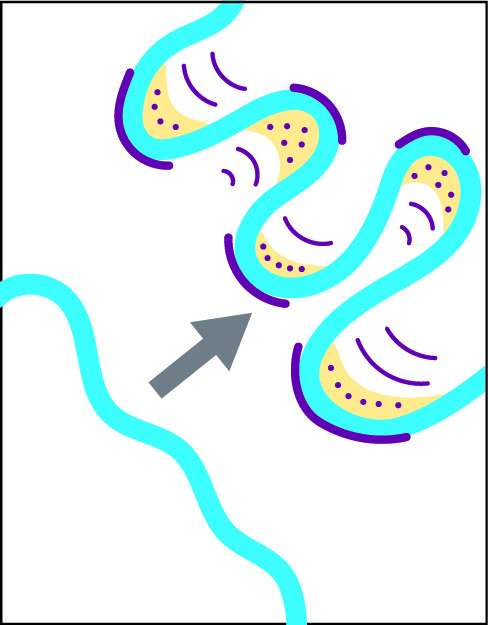 Gradual bend migration (erosion and deposition)
The lateral or side-to-side movement of a river, stream or creek over time through the deposition of sediments and other materials at point bars and the erosion of the outer bends.
-
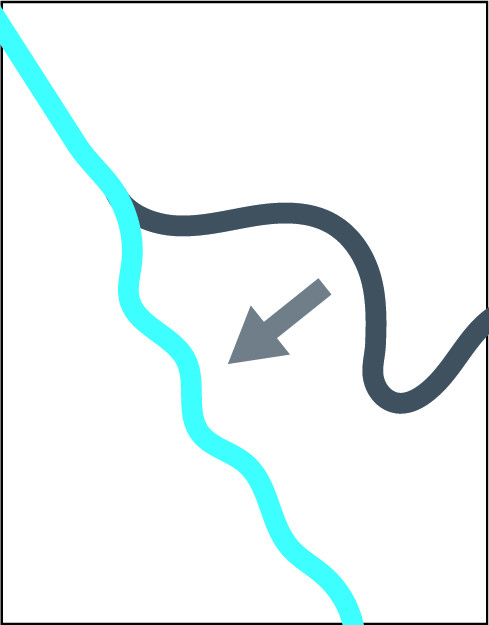 Abrupt channel switching (avulsion)
A rapid change in alignment of a channel where a sudden abandonment of channel occurs leading to the establishment of a new flow path typically the result of high streamflow events (for example: floods).
These physical processes may result in risk to life, property, and infrastructure.
Resources
More information about channel migration terms, processes, and hazards is available at:
Stay informed about channel migration hazards
- Follow local government bylaws, guidelines, and advisories.
- Check Alberta’s Flood Awareness Map Application to see whether your property is within a flood hazard area.
- Follow the Alberta River Basins website or mobile app for flood advisories.
- Keep an eye on weather forecasts and be prepared with an emergency plan in case you need to evacuate.
- Follow the Alberta Emergency Management Agency for information regarding emergency and disaster prevention, preparedness and responses.