Air quality monitoring
Alberta’s ambient air quality monitoring network is delivered through a distributed system, which includes industry, airsheds and the provincial and federal governments.
Monitoring station types
Traditional long-term monitoring stations are the most common stations making up Alberta’s AQHI network. To provide Albertans with a broader view of Alberta’s air quality, the network is augmented with other types of stations.
-
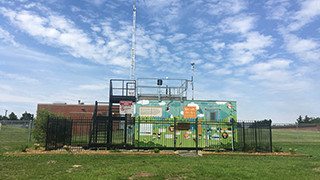 Traditional long-term monitoring stations
Traditional long-term air monitoring stations are usually operated in cities and near industrial sources.
Traditional long-term stations monitor the 3 main pollutants needed to report the AQHI (fine particulate matter, nitrogen dioxide and ozone) along with many other pollutants and meteorological parameters using methods in accordance with Alberta’s Air Monitoring Directive. Data from these stations have a high degree of accuracy, precision and reliability.
Deployment
Traditional air monitoring stations are large and costly to operate. These stations are normally set up as permanent infrastructure and typically deployed at a select location for multiple years. Stations deployed in this manner are commonly referred to as “permanent” monitoring stations.
Sometimes, traditional monitoring stations can be deployed at a location for a short term and are commonly referred to as "portable” stations.
Resources
View validated air quality data and reports from Alberta’s traditional long-term monitoring stations.
-
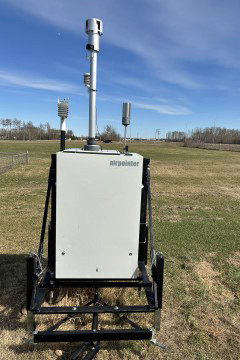 Airpointers
Airpointers are modular and portable air quality monitoring platforms. They are much smaller than a traditional station.
Airpointers use methods in accordance with Alberta’s Air Monitoring Directive to measure the 3 main pollutants targeted by the AQHI (fine particulate matter, nitrogen dioxide and ozone). Due to their modular nature, these monitoring platforms can be set up in different configurations for analyzing and measuring different pollutants and meteorological parameters. However, an Airpointer cannot accommodate as many parameters as a traditional station can. Data quality from an Airpointer should be consistent to that of a traditional station.
Deployment
Airpointers are relatively easy to transport, deploy and maintain, though additional consideration is required for calibration and operation.
-
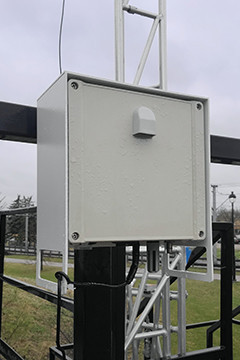 Aeroqual AQY Sensors (pilot project)
Alberta's government is piloting the use of Aeroqual AQY small air quality sensors to fill gaps in AQHI reporting. These sensors are much lower in cost and power consumption than traditional air monitoring stations or Airpointers.
Aeroqual AQY sensors do not use methods currently recognized by Alberta’s Air Monitoring Directive to measure air pollutants, and provide less accuracy and precision than measurements from traditional stations. However, these sensors have been successful in reporting the AQHI and changes in air quality.
Deployment
Aeroqual AQY sensors are portable and easy to transport, deploy, and maintain. Additional considerations are required for their deployments, as they are more susceptible to Alberta’s extreme temperatures and require co-location with traditional monitoring stations before and routinely throughout deployment for calibration.
Resources
Learn more about the Aeroqual AQY 1 Air Quality Sensor System.
-
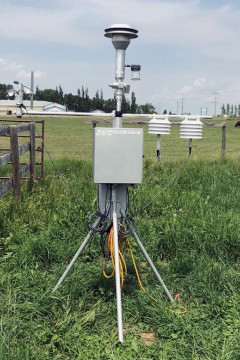 Environmental Beta Attenuation Mass monitors
Environmental Beta Attenuation Mass (E-BAM) monitors are small portable air monitors that measure particulate matter (PM10 or PM2.5) and meteorological parameters only.
E-BAMs do not report the AQHI. E-BAM monitors do not use methods currently recognized by Alberta’s Air Monitoring Directive to measure air pollutants and provide less accuracy and precision than measurements from traditional stations.
Deployment
We deploy E-BAMs in anticipation of and in response to wildfire activity as they are relatively quick and easy to deploy and move. Siting requirements include a power source and an open, secure space.
Resources