Background
Grasshoppers are a major pest of both cultivated crops and rangeland grasses. Traditionally, drier areas like southern Alberta are prone to recurring problems but serious grasshopper infestations can occur in cropland throughout the province.
Although the majority of grasshopper damage has been to cereal grains, other crops can be seriously affected. Crops such as canola and lentil can experience significant economic loss due to grasshoppers.
Forage losses are seldom estimated, but even a moderate infestation of 10 grasshoppers per square metre can consume up to 60% of the available forage, depending on the condition of the forage stand.
The type and extent of crop damage will depend on:
- crop type
- crop growth
- number of grasshoppers present
- whether adequate cultural and chemical controls are used
For current and past Alberta surveys and survey findings, see: Grasshoppers – Survey and maps
Grasshopper species
In Alberta, there are more than 85 species of grasshoppers. Only 5 of these are usually considered pest species. In the right conditions, large numbers of these pest species can accumulate and feed on crops.
In many cases, grasshopper control is not required if they are merely present and are not reaching economic damage thresholds. Grasshoppers have a significantly positive role in natural ecosystems as food for birds and other animals, including endangered species.
Distinguishing pest grasshopper species from non-pest species is necessary to control grasshoppers effectively.
Pest species
Two-striped grasshopper
The two-striped grasshopper (Melanoplus bivittatus) is common throughout Alberta. It has the heaviest body weight of the grasshopper pests discussed here. It rarely flies far but can walk well into a crop as it feeds.
-
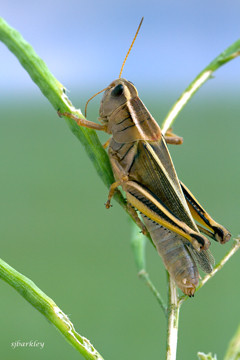
Figure 1. An adult two-striped grasshopper. Note the black stripe on the hind leg as well as the 2 distinct stripes on top of the body running the full length of the grasshopper.
Migratory grasshopper
The migratory grasshopper (Melanoplus sanguinipes) and Bruner’s grasshopper (Melanoplus bruneri) are difficult to separate in the field, but both can be significant pest species. Migratory grasshoppers are widely distributed but Bruner’s grasshoppers are usually found in northern Alberta.
-
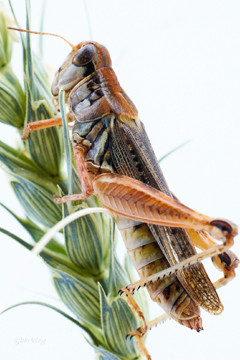
Figure 2. A migratory grasshopper (Melanoplus sanguinipes). This pest grasshopper can be recognized by the dark bands just behind the eyes.
Find out about the characteristics and life cycle of the Migratory grasshopper.
Clear-winged grasshopper
The clear-winged grasshopper (Camnula pellucida) can be found throughout Alberta; however, this grasshopper exhibits extreme fluctuations in abundance from year to year.
-
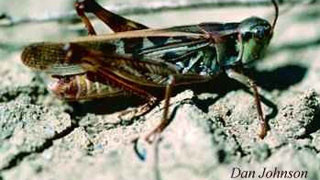
Figure 3. A mature clear-winged grasshopper female. Clear-wing grasshoppers have splotchy wings with light stripes above, but no stripe on their heads.
-
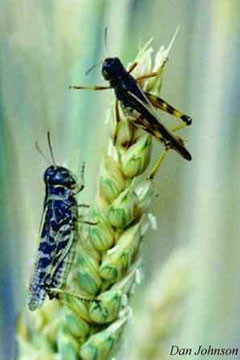
Figure 4. Clear-winged grasshoppers feeding on wheat.
Find out about the characteristics and life cycle of the Clear-winged grasshopper.
Packard’s grasshopper
The Packard’s grasshopper (Melanoplus packardii) occurs throughout the prairies, preferring loose sandy soils. There is colour variability in this species within Alberta, with southern specimens being generally paler. This species is less common than two-striped grasshopper and is a more moderate threat.
-
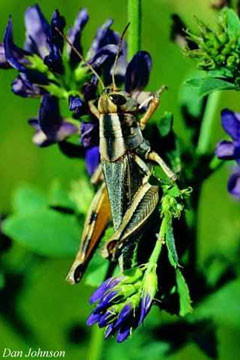
Figure 5. An adult Packard’s grasshopper (Melanoplus packardii) settling in on an alfalfa plant. Note the spotted hind legs and wings without stripes.
Find out about the characteristics and life cycle of the Packard’s grasshopper.
Non-pest species
Correctly identifying between pest and non-pest species is essential for effective and economical management. Observations of feeding behaviour and crop damage can assist with making management decisions.
Many non-pest grasshopper species are distinctive, although some look similar to pest species.
Band-winged grasshoppers
Band-winged grasshoppers, with brightly coloured hind wings are not pests. While in flight, these grasshoppers may produce a cracking sound with their wings. Generally, any grasshopper that makes sounds (cracking, singing, etc.) is not a pest species.
-
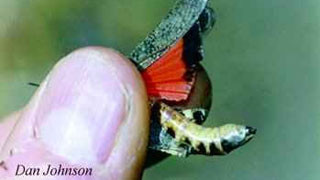
Figure 6. The coloured wings on these 2 band-winged grasshoppers are a clear sign that these are not pest species.
-
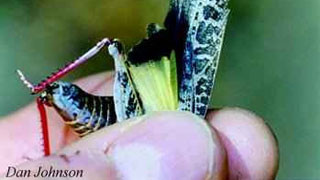
Figure 6a. The Carolina grasshopper with its black wings fringed with a pale border is probably the most noticeable member of the group.
-
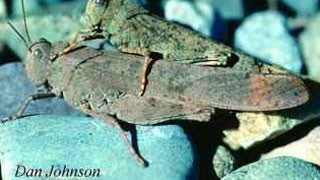
Figure 7. Ovipositing (egg-laying) Carolina grasshopper (Dissosteira carolina) female on rocks, guarded by a smaller male. The Carolina grasshopper is a band-winged grasshopper. This grasshopper is quite common and is easily recognized by its large black wings with a pale-yellow stripe. This grasshopper could become more of a pest concern on the prairies.
Slant-faced grasshoppers
Slant-faced grasshoppers are also non-pests. They are common along the borders of marshes and in wet meadows. The slant-faced grasshoppers feed primarily on rangeland grasses and sedges. Slant-faced grasshoppers are characterized by a slanting to nearly horizontal face.
-
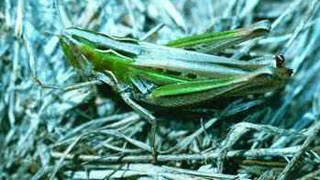
Figure 8. The velvet-striped grasshopper (Eritettix simplex tricarinatus) is a slant-faced grasshopper. Note the spines on the back legs that are used for ‘singing’.
Long-horned grasshoppers
Long-horned grasshoppers, such as katydids, are also not crop pests. They can be distinguished by antennae that are longer than their bodies.
Life cycle
The life cycle for all ‘economically important’ grasshoppers in Alberta is essentially the same. Female grasshoppers mate and lay their eggs in soil during the late summer and fall. Their eggs are laid in pods made of a hardened secretion deposited with the eggs.
Egg stage
Under optimum environmental conditions, a single female grasshopper may produce an egg pod every 2 to 4 days.
The eggs begin to develop once they are laid and continue until temperatures are too low. Some pest species can complete up to 85% of egg development prior to winter. Development resumes in the spring as the soil temperature rises.
-
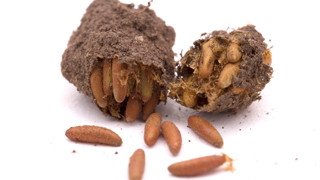
Figure 9. A grasshopper egg pod.
Nymph stage
Hatching of the pest grasshopper species begins between early May and mid-June. Newly hatched grasshoppers, or nymphs, are approximately 5 mm (0.2 of an inch) in length. In appearance, these nymphs resemble adult grasshoppers, except for their size and the absence of wings.
Nymphal development consists of growth interrupted by periodic skin shedding (moults). Each growth period is called an ‘instar’:
- Nymphs in their first and second instars are small.
- Third instar grasshopper nymphs have small but visible wingbuds developing.
- Fourth instar nymphs have more visible wingbuds.
- Fifth instar nymphs can be quite large and have partially developed wings.
When food is abundant and the weather is warm but not too wet, it will take 35 to 50 days for the nymphs to go through the 5 (occasionally 6) nymphal stages before becoming a winged adult.
Some of the non-pest grasshopper species overwinter as large nymphs and develop much earlier than pest species. Typically, any grasshoppers that are fully developed before June are not pest species.
Control
At high numbers, any type of grasshopper is considered a regulated pest in Alberta. Assess the damage present; if it needs control to prevent economic loss and the loss is greater than the cost of the control, then control should be taken.
Next to weather, natural enemies are the grasshopper's most important population control factor. In some localized areas natural enemies, such as disease, may cause even more mortality than the weather. Control measures can negatively impact natural enemies, so following economic thresholds is very important when considering control.
Find out about best management practices for grasshopper control, including weather effects, natural enemies, and cultural and chemical control methods.
Economic thresholds
The economic threshold or density of a pest at which control measures become economically viable has been established in most cereal crops. The economic threshold depends on several factors:
- stage of the insect
- type of crop
- crop stage
- growing conditions
- cost of control
- current market value of the crop
The most serious economic damage due to grasshoppers happens while the insects are in the third to fifth nymphal stages.
Since there are a number of factors to consider, the economic threshold in each situation can vary.
Thresholds for grasshoppers by crop
Preliminary economic thresholds for grasshoppers. Credit: J. Tansey, Saskatchewan Agriculture.
Oats and peas as guard strips
Both oats and peas are not preferred food sources for grasshoppers. Even if grasshoppers do feed on the crop, damage is limited. If choices are available, the grasshoppers will look for other food options, so these crops can be used as guard strips to protect a main crop.