Effects of weather
Temperature, rainfall, and snowfall each play a major role in determining the severity of a grasshopper outbreak. Temperature is the most important factor determining the size of the spring grasshopper population.
Fall temperatures
There are 2 main limiting factors of successful egg laying:
- rate of grasshopper development
- fall climatic conditions
Early adult emergence provides more time for egg-laying. Climatic conditions in the fall impact adult lifespan, fecundity, and activity. Temperatures will also determine the extent of embryonic development, affecting the time of hatching the following spring.
Winter temperatures
The effect of cold winter temperatures on grasshopper egg survival is minimal. Experiments conducted at the Lethbridge Research Centre have demonstrated that eggs can survive at -15 C. Soil temperatures in the field rarely fall below -10 C. Any effect on reducing egg survival would require conditions of wind, no snow cover and temperatures of -40 C for a number of days.
Spring temperatures
Spring temperatures only have a minimal effect on grasshopper survival. Young grasshoppers are hardy enough to survive low, even below freezing, spring temperatures for a short time. The most important aspect of spring temperature is its effect on the grasshopper development and plant growth. If the spring is hot, grasshoppers will hatch early and develop quickly. Cool spring temperatures will slow development. Crop development is also affected by less than ideal temperatures.
Rainfall
The relationship between temperature and rainfall controls the amount of crop damaged by grasshoppers. Under hot, dry conditions, a small grasshopper population may do as much damage as a large grasshopper population will under cool, wet conditions.
Moisture may also influence the size of the grasshopper population. During an extended drought, lack of water may slow the development of many eggs and can destroy eggs. However, it must be extremely dry before the grasshopper embryo begins to die under drought conditions.
Rainfall may affect a localized grasshopper population to a lesser extent. Rainfall will only decrease grasshopper numbers if a heavy downpour occurs immediately after an extensive hatch. A cool, wet June will not seriously decrease grasshopper populations.
The main effect of cool, wet weather is it:
- reduces crop losses by slowing grasshopper development
- increases the possibility of disease in the grasshopper population, helping to reduce next year's grasshopper population
Natural enemies
Next to weather, natural enemies are the most important grasshopper population control factor. In some localized areas, natural enemies may cause even more grasshopper mortality than the weather. Some natural enemies attack grasshopper eggs in the soil while others attack the nymphal and adult stages of the grasshopper.
Predators
Among the most important egg predators are bee flies, blister beetles, ground beetles (Image 1), and crickets.
Common field crickets eat grasshopper eggs, destroying up to 50% of the eggs in some areas. Bee fly and blister beetle larvae feed on grasshopper eggs in the soil. If bee flies and blister beetles are abundant, they may destroy up to 80% of eggs in a localized area.
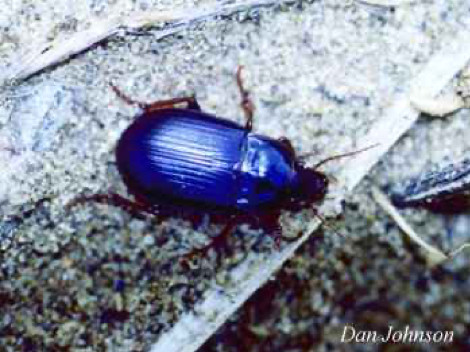
Image 1. Ground beetles are important grasshopper egg predators, actively seeking and feeding on grasshopper egg pods.
Nymphal and adult predators
Spiders (Image 2), robber flies (Image 3), some wasps, and many birds feed on grasshoppers and consume large numbers of nymphs and adults. Their effect on the total grasshopper population is not known.

Image 2. Banded garden spider preparing to feed on a grasshopper.
Many birds are predators of grasshoppers including gulls, hawks, crows, meadowlarks, crowned larks, lark buntings, desert horned larks, shrikes, curlews, killdeer, partridges, and cranes. Birds, especially gulls and meadowlarks, are credited with stopping some infestations in the early part of the century. This is more likely to happen if a habitat provides food and refuge for the birds. Farm habitat can be made more attractive to birds and so encourage predation of insect pests.
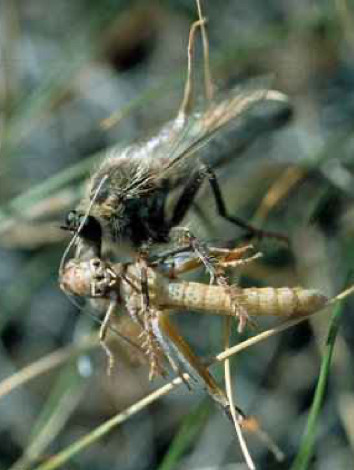
Image 3. Grasshoppers can fall prey to robber flies, one of which has just captured this white whiskers grasshopper, Ageneotettix deorum.
Opportunist animals will eat grasshoppers if they are available. Mice, rats, shrews, gophers and badgers all eat grasshoppers and their egg pods. Coyotes, skunks, lizards, snakes, toads, bobcats and kit foxes eat nymphs and adults.
Egg parasites
A few other insects, such as the tiny wasps of the genus Scelio, parasitize eggs just after they have been laid. The young parasitic larvae complete their development within the eggs in time to emerge as adults and parasitize the eggs of the next generation of grasshoppers. They can destroy from 5 to 50% of the grasshopper eggs.
Nymphal and adult parasites and diseases
This group contains many natural enemies including sarcophagid (flesh) flies (Image 4), muscoid flies, tachinid flies, tangled vein flies, threadworms, fungi, and microsporidians.
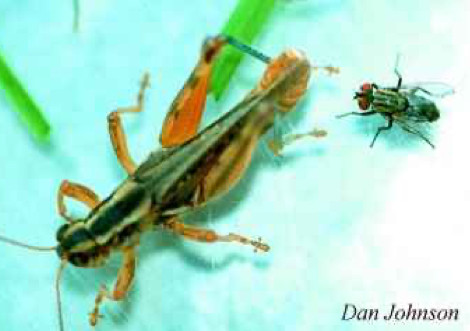
Image 4. This sarcophagid fly (Blaesoxipha atlanis) is about to deposit a larva directly on a Packard’s grasshopper (part of an experiment by T. Danyk). The larva will burrow into the grasshopper to feed internally and will leave only when fully developed and ready to pupate.
Parasitic fly larvae feed inside the adult or nymph grasshopper and eventually kill their hosts. This group of insects may parasitize up to 60% of the grasshopper nymphs and adults.
‘Threadworms’ are frequently found coiled inside grasshoppers. The threadworms overwinter in soil and lay their eggs on the soil or on vegetation. Threadworms attack grasshoppers if the young larvae encounter a grasshopper or if grasshoppers eat threadworm eggs.
The fungus, Entomophaga grylli, causes what is known as ‘summit disease’ in grasshoppers. The disease causes grasshoppers to climb and cling to the stems of plants before killing them. In warm, humid conditions the fungus can effectively control grasshoppers. This fungus may occasionally reach epidemic proportions.
The naturally occurring microsporidian parasite, Nosema locustae, causes grasshopper mortality, reduced egg laying, and reduced movement. A grasshopper becomes infected if it eats contaminated vegetation or a diseased grasshopper.
Grasshopper scouting
Assess the number of grasshoppers prior to making control decisions. Numbers can be estimated by counting grasshoppers in at least five locations in the adjacent roadside and/or within the field.
Count the number of grasshoppers within a 1 m2 area visualized ahead of you. Walk towards the area and count the number of grasshoppers that jump from that spot as you slowly walk forward. Count any grasshoppers that remain in the area once you are there. If grasshoppers are small, you may have to disturb or look under foliage. Repeat this process, but make sure to walk in a “zig-zag” pattern between locations for accurate counts.
While scouting, examining field edges for feeding damage can help with making management decisions. However, early in the season grasshopper nymphs may not have moved into crop fields yet so careful interpretation is needed.
Scouting for grasshoppers should begin early in the season, shortly after hatching. Control methods are more effective if conducted at the optimal stages.
Cultural control
Of all the methods available for grasshopper control, cultural control methods are generally the least expensive. Cultural control is a preventive approach to insect control and takes time to work. Effectiveness of these methods may be difficult to assess at first.
By modifying the grasshopper's environment at critical periods of its life cycle, a producer may reduce grasshopper numbers directly. They can at least affect their ability to reproduce.
Early seeding
Older plants that are growing vigorously can withstand more grasshopper feeding than younger plants, which are not well established. Although early seeding will not prevent crop damage entirely, it will reduce the amount of damage to crops.
Crop rotation
Avoid seeding cereals on stubble fields heavily infested with grasshoppers. Crops such as lentils and flax, which can be particularly susceptible to grasshopper damage, also should not be seeded on stubble fields where infestations of grasshoppers were high.
Guard strips
Both oats and peas are not preferred food sources for grasshoppers. Even if grasshoppers do feed on the crop, damage is limited. If choices are available, the grasshoppers will look for other food options, so these crops can be seeded as a border to protect a main crop.
Seeding rate
In winter wheat, grasshopper movement can be slowed by increasing the seeding rate at field edges. This strategy can decrease damage under high grasshopper pressure.
Grazing
On rangelands, grazing regimes that include periods of intense grazing and then allow vegetation regrowth have been shown to help lower populations of pest grasshoppers. Changes in plant community and microhabitat (humidity, temperature) impact grasshopper populations. Impacts appear to be site-specific, and further research is needed to develop general recommendations for this practice.
Tillage
Using tillage to control grasshoppers has to be considered carefully, especially under drought conditions. Tillage controls grasshoppers by eliminating the green plants on which grasshoppers feed, not by physically destroying grasshopper eggs or exposing them to predators. Excessive tillage is harmful in that it will reduce soil moisture levels and increase the risk of soil erosion.
Fall tillage immediately after harvest or in summer fallow can discourage female grasshoppers from depositing their eggs in these fields.
Early spring tillage or chemical fallow that eliminates all green growth on stubble fields can starve young grasshoppers when they hatch.
Tillage can be used as a last resort in fields where there are defined ‘hot spots,’ that is, where the young grasshoppers are continuing to hatch in large numbers and continued chemical applications are not desirable. In this situation, the tactic is to bury the eggs and hatching grasshoppers deep enough so that the young hoppers cannot make it to the surface.
Trap strips
Once grasshoppers have developed to the second stage of growth (second instar), they are usually mobile enough to move to adjacent crops when their existing food supply is exhausted. In these fields, trap strips can be used to collect grasshoppers into a relatively small area. It will then be possible to control the insects quickly and economically using a minimum amount of insecticide.
To make trap strips (see Figure 1 below), cultivate a black guard strip 10 m wide around the outside of a field. Leave an unworked green strip of at least 10 m before resuming cultivation. Repeat the process as often as necessary to produce additional trap sites. All green vegetation must be eliminated between the trap strips if they are to be effective.
Trap strip effectiveness can be improved considerably by seeding the strips to wheat or spring rye several weeks before tillage begins. The migration of young grasshoppers from the cultivated guard strips to the trap strips may take several days.
Once the migration is complete, the trap strips and a 10 m strip of any adjacent crop should be treated with an insecticide. The young grasshoppers are very susceptible to insecticides. The highest application rate recommended for the insecticide used should be applied to ensure adequate control is achieved.
Before cultivating the trap strips, wait 3 days to assess the effectiveness of the insecticide. If adequate control is not achieved after 3 days, it may be necessary to treat the trap strip again. When grasshoppers have been eliminated from the trap strip, it should be possible to complete tillage without fear of displacing large numbers of grasshoppers into the adjacent crops.

Figure 1. This represents the layout of a trap strip around the perimeter of a field. The black borders represent areas of the field that have been tilled, while the green area represents untilled blocks containing green plants. Grasshopper nymphs will be concentrated in the outermost strip, where they can then be controlled using an insecticide.
Chemical control
It is important to control grasshoppers before they become winged. A good size is 7 to 16 mm in length, or ½ to ¾ of an inch, when they are in their third or fourth life stage (instar). This stage has small, visible wing buds, but not fully developed wings. Targeting this stage for control balances nymphal susceptibility to chemical controls, lower mobility of non-flying grasshoppers, remaining potential feeding damage, and remaining waves of egg hatch. Once they become winged, they are much harder to kill.
Follow economic thresholds (overview page) when making control decisions for grasshoppers. Talk to your neighbours. Try to get large groups of farmers in one area to agree to control the grasshopper populations. This way the grasshoppers won't migrate from their unsprayed land onto yours.
Avoid spraying in high temperatures. At higher temperatures, grasshoppers metabolize chemicals faster and there is higher spray evaporation; both decrease efficacy. When it is cold grasshoppers may be under the canopy, making it harder to reach them with the chemical.
The ideal temperature range for spraying grasshoppers is 20 C to 25 C; most chemicals fit into this range and the grasshoppers should be active. Check the label for the temperature range of whatever chemical you are using to maximize its effectiveness.
For crops sprayed by aerial application, increasing water volume may be beneficial to ensure good coverage.
In rangelands, alternating treated and untreated swaths can provide similar levels of grasshopper control as treating the entire area. This technique decreases input costs and protects natural enemies of grasshoppers.
It is important to be realistic. If you have high population numbers, even with a 90% kill with an insecticide there may be numbers left that are still higher than the thresholds. Be aware of this. It might not be that the chemical is not working; it could just be that your numbers were high to start with.
Different chemicals have different residual times. If this is important check this the label.
Make sure the insecticide that you are using is registered for that crop. Registered crops can be found in Alberta’s Crop Protection Guide.
Insecticides may harm beneficial insects needed to pollinate some crops. For this reason, avoid spraying when the crop is in bloom.
Pasture and grazing considerations
Each insecticide has a different interval for the length of time that cattle have to be left out of the treated field before grazing. It can range from accessing the field immediately after application to waiting up to 14 days after application.
When applying insecticide to pasture or hay land, check to make sure that the insecticide is registered for all species of forage in the mix.
Ecobaits
Grasshopper baits are a pollinator and beneficial insect-friendly alternative option to foliar insecticides. Check with your local chemical dealers. They may be able to direct you to a spreader.