Overview
The Hazard Assistance and Resilience Program (HARP) replaces Alberta’s former disaster assistance programs – the Disaster Recovery Program (DRP) and the Municipal Wildfire Assistance Program (MWAP).
The HARP does not cover costs, damage or losses that could have been covered by insurance. A local authority must first apply to the Alberta Emergency Management Agency (AEMA) for a HARP and if approved, individuals and small businesses and other public sector applicants may apply for assistance within the program.
Approved HARP programs for 2025
HARPs approved for 2025 are:
- Alberta Early Spring Wildfires HARP for Athabasca County, Sturgeon County, MD of Bonnyville and Westlock County
- Alberta Late Spring Wildfires HARP for Town of Swan Hills and the Municipal District of Opportunity
- County of Grande Prairie Wildfire HARP
- Rocky View County Flood HARP
The program approval date for these programs is February 17, 2026 and approved local authorities have been notified.
The application intake period for private sector damage and loss under the Rocky View County HARP is now closed.
Contact your local authority for more information regarding approved HARP programs.
Cost sharing
The HARP includes a cost-sharing arrangement with local authorities (municipalities, Metis Settlements and irrigation districts) under which the Alberta government will provide assistance for 90% of eligible disaster costs and the remaining 10% is the responsibility of the applicant.
For individuals and small businesses who own their principal residence or small business location, a tiered cost-share arrangement applies. For further details, refer to the private sector funding limits.
Eligibility and funding
How to qualify for a HARP
Local authorities are eligible to apply for the approval of a program after a disaster in their jurisdiction. To qualify:
Eligible applicants under a HARP
If approved, a local authority will be eligible to receive HARP funding. A state of local emergency does not have to be in place to qualify for a HARP.
Once a HARP is in place, individuals, small businesses and other public sector applicants can apply to help restore damaged assets to a basic and essential functional condition. Only apply if your local authority has been approved for a HARP and has provided notice of eligible assistance, including application timelines.
How HARP works
HARP follows a structured process that begins with program application and ends with a determination of financial assistance.
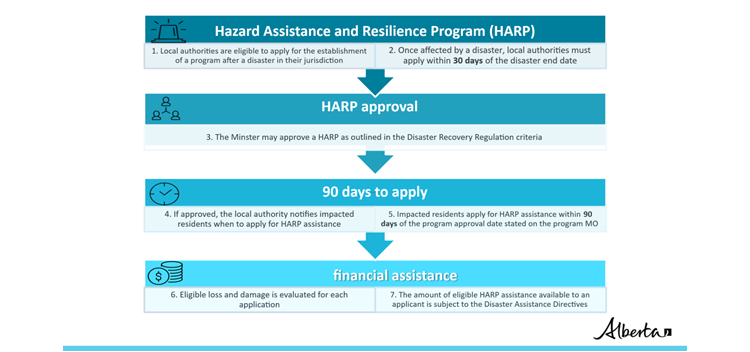
Approval for the establishment of a HARP may take several months. Local authorities will be notified in writing by the Minister of Public Safety and Emergency Services upon approval.
- Read Alberta Disaster Assistance Directives for eligible items and limitations for disasters after April 1, 2025.
How to apply
Application requirements for HARP assistance vary by applicant type.
Application forms and online access
Applicants may choose to apply online. An application form will be available for those who are unable or prefer not to apply online.
Contact [email protected] for assistance.
Private sector funding limits
The HARP follows a tiered cost-sharing model for individuals and small businesses who own (by title) their physical properties, where the cost-share applied by the Government of Alberta varies based on the number of times the HARP is accessed. A property address is eligible for up to a maximum of 3 HARP applications.
The tiered cost-sharing model
The tiered model is as follows:
Maximum financial assistance
The maximum assistance for homeowners and tenants is the lesser of:
- total replacement costs
- total cost of repairs to pre-disaster, basic and essential functional condition
- property tax assessment value of the building only (excludes land value) of the year immediately prior to the disaster or $500,000 adjusted for inflation yearly:
- this limit includes clean-up, replacement of lost or damaged contents, repairs, evacuation assistance and mitigation requirements set out in the HARP
- the maximum is not cumulative and applies each time an applicant qualifies into a HARP
See the HARP property search to see if your property has received assistance since 2021.
Contact Indigenous Services Canada for information on properties on First Nations reserves.
Insurance responsibility
Each person bears responsibility for protecting their personal property or business/agricultural operation. Insurance is a well-known form of risk transfer, where coverage of a risk is obtained from an insurer in exchange for ongoing premiums paid to the insurer. When someone has chosen not to insure their property when insurance was available, this is choosing to self-insure, so they bear the risk if a disaster happens.
The HARP does not cover costs for losses or damages to property that could have been insured. The HARP only covers damage, loss and costs caused by disasters that are considered uninsurable. See what hazards and perils are covered by insurance.
Resources
Application
Current directives
Fact sheets
- Homeowners and residential tenants
- Small businesses (French, Punjabi, or Tagalog)
- Local authorities
- HARP for individuals (French, Punjabi, or Tagalog)
- Metis Settlements
- 2026 Disaster Assistance Directives at a Glance
Flood risk information
Understanding your property’s flood risk is an important part of reducing future disaster impacts. Find detailed flood hazard mapping through the Flood Hazard Identification Program.
Contact
Connect with the Alberta Emergency Management Agency:
Hours: 8:15 am to 4:30 pm (open Monday to Friday, closed statutory holidays)
Phone: 1-888-671-1111
Email: [email protected]
Contacts for local authorities
For questions about applications, local authorities can contact AEMA recovery coordinators, AEMA field officers, or Wildland Urban Interface (WUI) field officers.