Notifications

Government mail service may be affected by the Canada Post labour disruption. Learn about how critical government mail will be handled.

Bow River Reservoir Options

The Alberta government is assessing options to mitigate the impacts of both flood and drought on the Bow River.

Flood mitigation on the Bow River continues with the Ghost Reservoir Infrastructure Project.

Overview

Alberta’s government continues to explore options to build additional flood and drought storage capacity on the Bow River to reduce the impacts of severe weather events on Albertans and the economy.

Following a thorough feasibility study, we have decided to move forward with additional exploration of the Relocated Ghost Dam option. This is an expansion of the existing Ghost Reservoir to protect downstream communities on the Bow River and provide water security for the Bow River basin.

The Relocated Ghost Dam option is being explored further in the Phase 3 Engineering and Regulatory Approval Process.

Alternatives to the water storage options being assessed in the feasibility study were also assessed. The alternatives bring with them significant treaty rights issues, environmental impacts, regulatory challenges, and/or poor cost-benefit ratios. To date, no suitable feasible alternatives have been found that provide the water storage needed for water security during drought and mitigating flood impacts without significant issues.

Although the Phase 1 Conceptual Assessment and Phase 2 Feasibility Study and Alternatives Assessment were led by Alberta Environment and Protected Areas, Phase 3 is being led by Alberta Transportation and Economic Corridors (TEC). Information from Phase 1 and Phase 2 has been transferred to TEC.

In Phase 3, the Bow River Reservoir Options initiative will be known as the Ghost Reservoir Infrastructure Project (GRIP), as the Relocated Ghost Dam option was selected in Phase 2. More information regarding the project will be shared with the public when known.

Email questions regarding GRIP to [email protected].

Study corridor map

The map below shows the feasibility study location of the Relocated Ghost Dam. Details regarding the dam location and reservoir extent are subject to change as additional data are collected and analysis is completed.

Figure 1. Feasibility study location and extent of the Relocated Ghost Dam reservoir option.
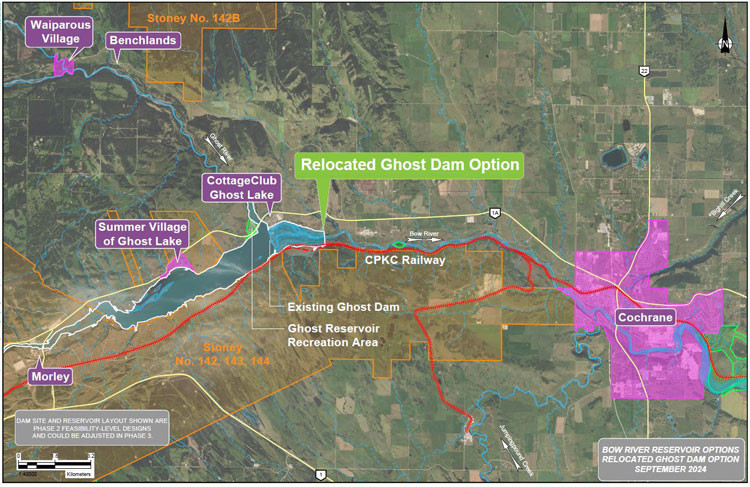
Bow River Reservoir Options Relocated Ghost Dam option location map

View map in PDF

Project timeline and phases

The selection and potential implementation of a reservoir option on the Bow River upstream of Calgary is being approached in 4 phases:

  • Phase 1: Conceptual assessment (completed March 2020)
  • Phase 2: Feasibility study (completed March 2025)
  • Phase 3: Engineering and regulatory approval process (commencing)
  • Phase 4: Procurement, construction and commissioning (potential)

Phase 3. Engineering and regulatory approvals process

  • Overview

    We have moved the Relocated Ghost Dam option forward to the Phase 3 Engineering and Regulatory Approvals Process. In Phase 3, the Bow River Reservoir Options initiative will now be called the Ghost Reservoir Infrastructure Project, as the Relocated Ghost Dam option was selected in Phase 2.

  • Engineering and design

    During the engineering and design process, detailed site investigations, analysis and design will be completed for the project.

  • Regulatory approvals

    The project will be evaluated by the appropriate federal and provincial regulatory bodies. Assessments will be conducted to examine the effects on the environment and determine if the project is in the public interest.

  • Land acquisition

    We will start to proceed with applicable land acquisition during Phase 3 in preparation for future construction of the project.

  • Engagement

    Engagement with Indigenous communities and organizations and engagement with relevant stakeholders and property owners will be completed as part of Phase 3.

Phase 2. Feasibility study

  • Overview

    In spring 2021, we began engagement and field studies for Phase 2 of the Bow River Reservoir options initiative, the feasibility study. The final feasibility study report is now available.

    The Bow River Reservoir Options feasibility study looked at 3 reservoir options in the Bow River basin, upstream of Calgary:

    • Relocated Ghost Dam: An expansion of the existing Ghost Reservoir
    • Glenbow East: A new reservoir between Cochrane and the Bearspaw Dam at the western edge of Calgary
    • Morley: A new reservoir between Seebe and Morley, on Stoney Nakoda Nations reserve lands
      • To save time and money, we determined the Morley option was not feasible.
  • Feasibility study

    Through the feasibility study, we deemed the Relocated Ghost Dam to be the best option. It is significantly better than the Glenbow East option with a lower cost, and can meet the drought and flood mitigation performance objectives with fewer social and environmental impacts. The Relocated Ghost Dam has a smaller project footprint than the Glenbow East option, and fewer overall impacts to the environment, property and infrastructure, while providing comparable water storage.

    Phase 2 assessed technical feasibility, while carefully considering the following elements:

    • cultural
    • economic
    • engineering
    • environmental
    • social

    The feasibility study started in spring 2020. For each option, the study looked at:

    • technical feasibility
    • effectiveness in mitigating flood and drought risk, while also providing water management flexibility
    • potential impacts on communities, the environment and infrastructure
    • costs and potential benefits
    • additional engagement opportunities for Indigenous groups, stakeholders and the public

    We worked with WSP E&I Canada Limited to complete the feasibility study report.

  • Bow River Working Group

    The Bow River Working Group has supported sustainable water management in the Bow River Basin over the last decade. The mandate of this advisory group during Phase 2 was provide feedback and suggestions to Alberta’s government on the feasibility of the reservoir options identified in the conceptual assessment with the aim to reduce future flood damage, mitigate drought and improve the reliability of water supply in the Bow River basin.

    The Bow River Working Group includes members from:

    • municipalities along the Bow River, including the City of Calgary, Cochrane, the Summer Village of Ghost Lake, MD of Bighorn and Rocky View County
    • First Nations
    • industry, including TransAlta
    • irrigation districts
    • Bow River Basin Council
    • environmental organizations
    • provincial and federal government departments
  • Fieldwork and land access

    As part of the feasibility study, the consultants carried out fieldwork to learn more about the potential dam sites and the surrounding areas.

    The fieldwork included:

    • geological (visual mapping), geotechnical (drilling boreholes) and geophysical (ground-based surveys) work to better understand the soil and bedrock conditions at the dam sites and surrounding lands
    • environmental field studies of the reservoir areas and surrounding lands to evaluate the existing vegetation, wetlands, wildlife, fish and cultural and historical resources

    The geological and geotechnical information helped the study team evaluate the technical feasibility of constructing a dam at any of the potential locations, and how to design the dam. The environmental data gathered helped us better understand the existing environmental conditions around each potential site, and the potential impacts of building a dam and reservoir.

  • Property owner information

    Information for landowners is posted on the Bow River Reservoir Options engagement page.

    No studies were undertaken on any property without proper permissions.

  • Indigenous and stakeholder engagement

    The feasibility study engagement process built on the engagement completed in the conceptual assessment. It also informed the alternatives assessment.

    Learn more about the engagement process.

  • Feasibility study findings

    Findings supported the feasibility study objective whether there or not there was a feasible option to proceed to Phase 3. Through the feasibility study, we deemed the Relocated Ghost Dam to be the best option.

Phase 2. Alternatives assessment

Findings supported the alternative assessment objective to confirm whether or not there were any suitable alternatives to a reservoir. No suitable feasible alternatives have been found that provide the water storage needed for water security during drought and mitigating flood impacts without significant issues.

Phase 1. Conceptual assessment

  • What we learned

    A conceptual assessment was completed for the 3 reservoir options on the Bow River upstream of Calgary:

    • Morley: A new reservoir between Seebe and Morley, on Stoney Nakoda Nations Reserve land
    • Relocated Ghost Dam: An expansion of the existing Ghost Reservoir
    • Glenbow East: A new reservoir between Cochrane and the Bearspaw Dam at the western edge of Calgary

    The assessment began in November 2018 and concluded in spring 2020. This assessment, primarily a desktop study based on existing information, considered 3 reservoir options at a high level of conceptual design. High quality drone footage of existing conditions along the Ghost and Glenbow stretches of the river was also collected and used in the assessment.

    Information gathered from Indigenous communities and organizations, stakeholders and the public on social, environmental and cultural considerations, traditional land use and engineering and economic information was used to help further inform the assessment outcomes.

  • Assessment findings

    Findings confirmed the conceptual assessment objective whether or not it is possible to increase flood and drought storage at all 3 reservoir option sites. No comparisons between the 3 reservoir options were made during the assessment.

  • Conceptual Assessment Report

    The Conceptual Assessment Report was submitted to the Alberta government in spring 2020.

Additional information

Contact

Connect with the Ghost Reservoir Infrastructure Project:
Email: [email protected]

For questions about Phase 1 and Phase 2:
Email: [email protected]

All fields are required unless otherwise indicated.

Update type: