
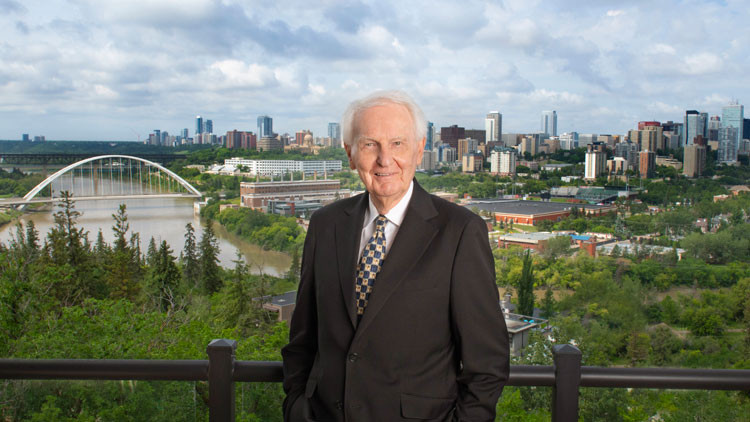
Ron Triffo of Edmonton has dedicated his time, energy and resources to building a better community through activity and investment in post-secondary education, performing arts, health care and initiatives that improve quality of life in Alberta. And he did something more. He helped build one of the world’s most sustainable companies – Stantec. Engineering and business endowments, as well as buildings at MacEwan University and the University of Alberta, carry his name. More than that, they hold the promise of tenacity, creativity and vision.
Ron was born in Winnipeg in 1939. As the middle child of 5 born to immigrants who came to Canada from the Austro-Hungarian Empire, he got the education his parents wanted for him. “They arrived with nothing, but they had a pocketful of hope,” he said of his parents, Bruno and Mary, who arrived in Winnipeg in 1926, aged 18 and alone. It was there that they met, deprived of a formal education due to the Great War and instability in the region. But it was also in Canada that they set their hopes for a generation that could thrive with the right education and a lot of hard work.
“They were independent at a young age, and I was very independent at the same age.” His dad found work in a steel company and his mother worked as a maid, both putting in long hours that left Ron to grow up with street smarts. He, too, started working at age 7 or 8, running a paper route. Every person working in the Triffo family could help the family establish itself. It is a work ethic bred in the bone, and he has carried it with him all his life. “You learn to fend for yourself, to look for ways to be resilient, to be resourceful, and to work hard.”
Yet there was always a sense of a community in the neighbourhood. Since the Triffo family had no extended relations nearby, they relied on the people around them, just as their neighbours relied on them. Those relationships would prove invaluable when they opened a corner grocery store. Ron, aged 14, became the bookkeeper, delivery person, order manager, stockkeeper, and sometimes translator. “I laugh when people ask me where I get my business sense. Running a corner grocery store is my answer.” Staying on top of suppliers, inventory, credit, and the special talents needed to deal with individual customers gave Ron a lesson textbooks could not.
Textbooks, however, created a bridge to an excellent education. Proficient at math and science, Ron sought advice from the school guidance counsellor about next steps. Engineering, they said, which sounded good to the teenager who had no idea what that meant. After graduating with a degree in civil engineering in 1961, he took courses in urban planning through the University of Manitoba’s School of Architecture. A scholarship to pursue graduate studies at the University of Illinois brought him face to face with a tool few others in Canada were using for engineering in the 1960s: a computer. “It was hardly rocket science at that time, because the computer was 64K. When I came back to Canada, I found I was recognized as a pioneer by being one of the few people in Canada who was capable of simulating urban systems by computer.”
Returning home to Manitoba to work for Metro Winnipeg and then to Calgary to conduct long-range transportation studies, Ron’s first years back working in engineering culminated in a move eastward to Montreal to work with the federal public service. But the desire to move back into the private sector eventually moved him to Edmonton with his wife Dorothy and daughters Karyn and Dyan.
“I found out that my real passion was actually as a businessperson. The business happened to be engineering,” and the company was Stanley Associates Engineering. It was in 1977 that Ron joined the late Dr. Don Stanley (AOE-1998), who founded the company in the mid-1950s. By 1983, Ron was running the organization after an economic collapse in western Canada as a result of the Canadian National Energy Policy of that time. “Projects were cancelled; the lights went out. It was terrible and companies had to let people go with virtually no notice. We did: 200, down from 400 in one weekend, all gone. That's when Don Stanley said, ‘Here's the keys, Ron. You run it. I don't want to do this anymore.’”
Ron, starting his tenure in this time of turmoil, saw that surviving meant adapting. The company’s future depended on diversifying its base, protecting it from ever weathering a downturn like that again. From civil engineering, Ron expanded the company through acquisition to include a variety of engineering disciplines. Building from a solid financial foundation that his mentor, Don, established, Ron was able to provide exit strategies and opportunities that otherwise were not available. As chief executive officer, he expanded the company from the 200 employees he inherited to 1000 within 10 years, offering a broader range of services and geography.
In 1994, Ron led the corporate transition that was the beginning of the modern-day Stantec – a listing on the Toronto Stock Exchange. In 1998, he became Stantec’s chairperson, a position he held until 2011. Nearly 40 years with the corporation, he has left more than a passing imprint on it. He brought work and opportunity to people in Alberta in challenging times. Today, the company is nearly 35,000 strong in locations around the globe and is recognized as one of the top 10 design firms in the world.
When asked about his recipe for success, there is a spark in Ron’s eye as he twists the first letters of his philosophy from EOA – education, opportunity, attitude – to AOE, making the connection to this new honour. “Successful people are the result of a marvellous melding of 3 ingredients: education, opportunity and attitude. This beautiful province of Alberta has all the world-class institutions, companies and resources you will need for your education and opportunity. Attitude, however, is all on you. To succeed, just bring the right attitude to the table.”
The sense of community instilled in him from his youth still moves him. Ron has been made a Fellow of the Canadian Academy of Engineering for his contributions to the field and is a laureate of the Northern Alberta Business Hall of Fame (2005), the same year he was awarded the Alberta Centennial Medal. The University of Alberta awarded Ron an honorary doctor of laws degree (2011), followed by MacEwan University (2026) – especially meaningful as he is also the namesake of MacEwan’s Triffo School of Business and its Triffo Theatre. Ever the civil engineer, he has generously restored the University of Alberta’s Triffo Hall and brought light and modernity to the historic 1915 brick South Lab building, one of the oldest buildings on campus. And it is at the Cross Cancer Institute, also in Edmonton, that the Triffo Virtual Care Centre takes specialized care into communities while the Dorothy Triffo Atrium bears his late wife’s name, giving patients and their loved ones a place to rest.
One of Ron’s endowments is for the University of Alberta’s Engineering Incubator, a brilliant fit with his own career. The incubator supports enterprising students to prepare their own innovations for pitch competitions with the objective of bringing innovations to market instead of losing them in labs.
His support for community and industry brought Ron to new leadership roles and his lighthearted nickname with his peers as “Mr. Chairman.” At various times he chaired ATB Financial, Edmonton Telephones, Alberta Innovates-Technology Futures, the Alberta Ingenuity Fund, and the Alberta Economic Development Authority. He was a long-serving member of the TELUS Board. As a member of the Northern Alberta Institute of Technology board of governors and the Business Advisory Council of the University of Alberta School of Business, Ron inspired ways to connect education and opportunity. Active in the engineering profession, Ron is a past president of both the Consulting Engineers of Alberta and the Association of Consulting Engineers of Canada.
In thinking about his enduring contributions, Ron credits the unfailing support of his wonderful wife and children and the values that shaped his early life. Education, opportunity, attitude – the 3 strands of his philosophy – have shaped a lifetime of work and of giving, and reflect the determination of a family that came to Canada seeking a better life. Those values continue through his 2 daughters – Dyan and the late Karyn – his 4 grandsons, his friends and his community.
“I was brought up in an environment where we didn’t have a lot of money to share, but caring and helping hands in the neighbourhood – that was what you did.” It is the essence of life, in his DNA, to build and to give back. “Looking back, I would hope I am known as a person who loved his family, his friends and his community. That I was here, I participated, I loved it and I left it better. And if that’s true, I’ll have done honour to all.”