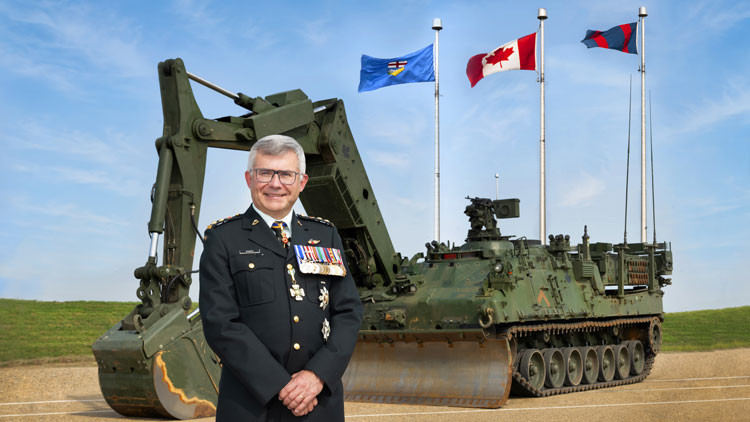
Lieutenant-General (Ret’d) Paul Wynnyk of Sherwood Park served in the Canadian Army for 38 years, retiring in 2019 after rising to vice chief of the defence staff. It was the culmination of a remarkable career recognized in Canada and abroad for leadership, diplomacy and service. Paul distinguished himself in successive postings, earning progressively greater responsibility until he eventually commanded the Canadian Army. His capacity for strategic planning and implementation made him the person to call upon in times of uncertainty, crisis and change.
Paul’s route to extraordinary leadership started small, though his sense of adventure has always been grand. Born in 1964 and raised in Breton, Alberta, the grandson of Ukrainian immigrants grew up with a love of the outdoors and an appreciation for the hard work required to build a life there. His parents, Walter and Joan, encouraged a sense of belonging to a world both wide and full of possibility.
Walter was principal of Breton High School and a Canadian Army veteran of the Second World War. “He was 15 to 20 years older than most of my friends’ dads, but he also had 15 to 20 more years of lived experience and wisdom that I benefitted from immensely.” That perspective, and his father’s example of service, stayed with Paul.
He thrived in Cub Scouts, where he learned teamwork, and explored the world through his father’s home library, developing an enduring love of history. Walter also served as commanding officer of the local Army Cadet Corps. Encouraged to try Cadets for at least a year, Paul quickly embraced the outdoors, challenge, and sense of purpose. Through Cadets, he completed the Duke of Edinburgh International Award program, receiving his Gold Award from His Royal Highness the late Duke of Edinburgh.
While still in high school, Paul joined the Army Reserve in Edmonton. “At the age of 16 and a half, I would get up on Saturday mornings at 4:30 am. I would drive the 100 kilometres into Edmonton to parade with the reserve unit there – the 20th Field Artillery Regiment. And then I would drive back.”
The structure, challenge and adventure of military life resonated with him. The week after graduating from high school, Paul joined the regular army, completing basic training before beginning engineering studies at Royal Roads Military College in Victoria. He completed his degree in civil engineering at the Royal Military College of Canada in Kingston in 1986, then deployed to Germany as a combat engineer officer during the latter stages of the Cold War. A few years later, he moved to Gagetown, New Brunswick, continuing a career that would eventually take him across Canada and around the world.
Before turning 33, Paul was promoted to lieutenant-colonel and returned to Edmonton to command 1 Combat Engineer Regiment, making him one of the youngest commanding officers of a major unit since the Second World War.
“A lot of things like this are luck and timing,” he says, though experience, preparation and aptitude played their part. As Paul moved through the ranks, one principle remained constant: serve where he was needed. “As I went along, doors opened. I was always the sort of person who said ‘yes.’ If they offered something, I would never refuse because my job is to serve, not to tell people where I’m going to serve.”
His service took him into increasingly complex operational and strategic roles. In the Democratic Republic of Congo, Paul served with the United Nations mission and helped oversee the evacuation of thousands of civilians following the 2002 eruption of Mount Nyiragongo. The experience demanded calm judgement, co-ordination and leadership in circumstances where lives depended on decisions made quickly. In Afghanistan, he advised senior U.S. and Afghan political and military officials and led a multinational team charged with developing the Afghan National Army.
His leadership was also tested at home. In 2011, when Manitoba faced a historic flood, Paul led a Canadian Armed Forces response involving almost 2000 personnel. The assignment strengthened the crisis leadership, intergovernmental experience and operational judgement that would define many of his later roles.
In 2014, Paul was asked to lead military intelligence. “I think you got the wrong guy,” he told the chief of the defence staff. “I’ve never served in an intelligence role in my entire life.” His operational experience was precisely why he was chosen. Paul later described it as “the most fascinating thing I’ve ever done.”
The call to serve continued. Paul became only the second Alberta-born officer since 1875 to command the Canadian Army. In that role, he oversaw regular and reserve forces while contributing to national defence policy and serving as the Indigenous Peoples champion for the Canadian Armed Forces.
Paul played an important role in Canada’s renewed military engagement in Europe, including support for Ukraine and Latvia. For the grandson of Ukrainian immigrants, Canada’s support for Ukraine held particular meaning. His leadership and longstanding support for Ukraine and the Ukrainian-Canadian community were later recognized through the Ukrainian Canadian Congress Shevchenko Medal and the Tryzub Leadership Award.
In 2018, Paul was appointed vice chief of the defence staff. He was the first Albertan to hold the position and became the most senior Alberta-born individual in Canadian military history. As second-in-command of the Canadian Armed Forces, he helped oversee defence priorities and procurement and served as the champion for ethics.
When Paul retired from the military in 2019, one chapter of service closed and another opened in Alberta.
He joined the Government of Alberta and brought decades of crisis leadership to the provincial public service. While overseeing the Alberta Emergency Management Agency, Paul helped manage responses to major emergencies, including flooding in Fort McMurray and devastating wildfires.
During the COVID-19 pandemic, while the deputy minister of Municipal Affairs, he also led major provincial response efforts, including the COVID-19 Personal Protective Equipment and Vaccine task forces. He went on to serve as deputy minister in Health and Intergovernmental Relations before concluding his public service career in 2025 as acting deputy minister of Executive Council, the highest position in the Alberta Public Service.
Paul continues to serve the public interest as registrar and CEO of APEGA, the Association of Professional Engineers and Geoscientists of Alberta, helping uphold the standards of the profession in which his own career began.
Paul’s commitment to service extends well beyond his professional roles. He serves as colonel commandant of the Canadian Military Engineers and honorary president of the Army Cadet League of Canada. He is also a governor with the Commissionaires of Northern Alberta, Northwest Territories and Nunavut, and serves on the Regimental Senate of the Argyll and Sutherland Highlanders of Canada. His broader involvement has included support for veterans, military history, civic organizations, international affairs, and charitable causes, including the Royal Canadian Legion, United Way, and the Duke of Edinburgh’s Award.
His contributions have been recognized widely. Paul’s Canadian honours include Commander of the Order of Military Merit, the Meritorious Service Medal, the Queen Elizabeth II Diamond Jubilee Medal, the King Charles III Coronation Medal and the Queen Elizabeth II’s Platinum Jubilee Medal (Alberta). He was appointed a Fellow of the Canadian Academy of Engineering and received an honorary doctorate in Military Science from the Royal Military College of Canada.
Internationally, Paul has received state honours from Colombia, Brazil, Chile and Afghanistan, as well as recognition from the United States, including the Officer of the Legion of Merit and awards for leadership in the international intelligence community.
Notwithstanding a career that took him far from home, Paul has never stopped identifying strongly with Alberta.
“I’ve spent more of my life outside of Alberta than in, but my heart has always been in Alberta, and I knew when I joined the military that I always wanted to come back. It’s hard to quantify. There’s something different about Alberta. I think it’s the spirit of the people. I have noticed Albertans will roll up their sleeves, they won’t complain, they’ll get down to work and they’ll get things done. It’s not the same everywhere else. And, maybe because I was raised here, it’s just always been home.”
After a lifetime of leadership and public service, Paul most looks forward to weekends at the lake with his wife, Dr. Marianne Howell. He describes her as a remarkable partner and supporter who pursued her own distinguished teaching career at the University of Alberta’s School of Dentistry. “To me, this honour is just as much hers as it is mine.”
Paul began his career building bridges as an engineer and has spent the decades since building connections people can depend on – between soldiers and civilians, governments and communities, Canada and its allies.
It has been, and continues to be, a life of service grounded in gratitude.
“I hope others will say he did his very best to serve his country and his province. I got that from my dad: how important it is to give back to a country, a province, and a society that has given so much to our family.”