
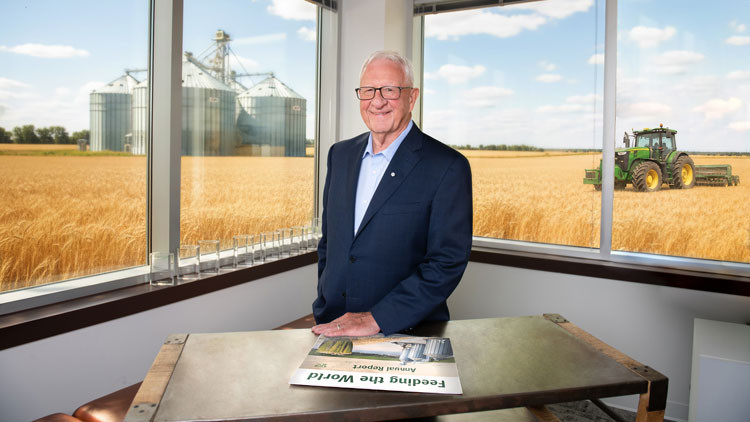
Kim McConnell co-founded an internationally renowned agriculture communications business and created momentum for people to learn more and care more about where their food comes from and how it is produced. Through board leadership and advisory roles in Canada and the United States, he has shaped efforts to elevate and advance Canada’s agriculture and food industry, helping strengthen its global profile. Yet it is his remarkable commitment to uplifting others, from youth to seniors, that continues to inspire his leadership. At heart, it has always been about building community and helping it to thrive.
He was born into it. In 1956, Kimberley Kent McConnell entered a family that had been farming the same land in Hamiota, Manitoba, since 1884. That land was home. It still is in many ways and he has always wanted to be connected to it. But before Kim could return to the family farm, his parents, Red and Ruth, set two conditions for him: get an education and do something off the farm for 2 years. Sage advice, but hard to follow for someone whose blood runs 4-H green.
At the University of Manitoba, Kim pursued a bachelor of science degree in agriculture before taking a position in Edmonton with crop inputs manufacturer Elanco. In Edmonton, he also found an exceptional life partner, his wife Carolyn. Still drawn to the fields and with conditions met, Kim moved back to Manitoba in 1980 to farm with his parents for one growing season while Carolyn completed her studies.
Life had other plans, and the farm would have to wait. Elanco wanted him back, this time in Toronto. That was a non-starter for Kim, though he and Carolyn agreed to move to Calgary for a job in advertising he knew nothing about. The 2 married the following year.
It was the early 1980s, a time when agricultural technologies were blossoming, but the companies providing them did not know how to talk with farmers. Kim saw this fallow field between producers and consumers and realized he held the seed of an idea at hand: create a company focused only on communicating with and advertising to farmers and the agri-food community. He was uniquely qualified to bring both sides together.
Money had been tight, but the possibility? That was wide open, thanks to Carolyn. She said, “McConnell, you’ve got one year. At the end of the year, we’ve got to decide, are we going to do this? Are we going to go back home to farm or are we going to get a job?”
Reactions from other family members showed their bewilderment. His mother and mother-in-law thought he had lost his mind while his father-in-law offered prayers. “And my dad said, well, I have absolutely no idea what you're doing, but you've made some pretty good decisions in the past and good on you. Good luck.”
Good ideas need more than good luck, and Kim found it in the professionals who joined him in this journey. He founded Fieldstone Marketing and Communications in 1984 and grew the company until it merged in 2002 to become AdFarm, one of the largest agriculture-focused agencies in North America, and the largest ad agency between Toronto and Vancouver at the time. Focused only on agriculture, AdFarm grew from Alberta to offices in Missouri, California, Iowa, North Dakota and Ontario, with a consulting division in London, England. AdFarm was recognized as one of “Canada’s 50 Best Managed Companies” and among the “Best Places to Work in Canada” multiple times.
His one-year lease on the idea proved a good investment. Twenty-three years later, Kim stepped down as CEO of AdFarm, although he remains a strategic advisor. He realized, “I have good health, I have good energy, I have a great family, and I have wonderful connections.” As it turned out, he had more good ideas. Closing the chapter on what he calls his Operational Leadership phase in 2007, he started Phase Two: Directional Leadership.
Serving on corporate and non-profit boards, Kim could offer his business, communications and agricultural insight while keeping the community growing. He had gone from promoting soil nutrients and technologies to helping shape the future of agriculture with his vision and business savvy. One example was the need to connect science, supply chain and sustainability in Canada’s beef industry. That work led to the launch of the Canadian Roundtable for Sustainable Beef in 2014, bringing together producers, food services, government, environmental agencies and youth. It was a clear example of Kim’s ability to think through systems, recognizing that healthy environments for cattle benefit the entire value chain.
Over the years, Kim has brought his leadership to more than 30 corporate and community affiliations. He remains actively involved with many, including the Canada West Foundation, the CN Agricultural Advisory Council, the Farmers Equity Trust, the Business Council of Alberta, Long View Systems, Magna Engineering Services, and VistaVu Solutions.
Kim’s extensive board involvement has spanned agriculture, business and community. He has served on organizations such as the Calgary Stampede Foundation, Canadian Agri-Food Policy Institute, National Circle for Indigenous Agriculture & Food, Canadian Agri-Marketing Association, G-Mac’s AgTeam, Genome Canada, Alberta Livestock & Meat Agency, Canadian Centre for Food Integrity, the Alberta Institute of Agrologists, YMCA Calgary, The Salvation Army, the Credit Union Deposit Guarantee Corporation, and Anuvia Plant Nutrients in Florida.
The family farm inspires him still as he sees strong potential to build an agri-food industry that benefits Canada and the world. Pulling together, they can create environmental and economic sustainability, especially for rural communities. “If we look at the future of Canada, it is in our natural resources, whether it is in energy or mining or agriculture or critical minerals or fisheries. Those do not happen in downtown Toronto or downtown Edmonton. They happen in rural communities. And if we don't have vibrant rural communities with hockey rinks, hospitals, and schools and things like that, then we won't have people to do the work and Canada will not achieve its full potential.”
It was through 4-H, the youth development organization, that Kim began to practise his leadership skills and develop a profound and lasting love for rural life. In recent years, Kim joined the effort to revitalize the program so youth can build the skills and compassion he gained so many years ago. He has been a champion for 4-H Canada and the Canadian 4-H Foundation, becoming an Honorary Member of 4-H Canada in 2020.
Kim is living proof that there is no school like the farm to learn about business, the environment, sustainability, volunteering and contributing to a vibrant, healthy community. In an increasingly digital world, Kim wants youth to have hands-on experiences that open new opportunities throughout their lives.
Learning is central to this, his Inspirational Leadership phase of life. Kim is encouraging others to learn from the wisdom of seniors. Enter Top 7 Over 70, an awards program created in 2017 by Jim Gray (AOE-2002) to celebrate the accomplishments of people who have forged new paths after the age of 70. Kim has been excitedly working to expand this program from Calgary to other parts of the country as chair of Top 7 Over 70 Canada.
He brings that same commitment to those he mentors now – from Indigenous youth and emerging business executives to up-and-coming leaders in the Cattlemen’s Youth Leadership program. Mentorship for Kim is about helping people make connections and recognize that they are neither alone nor expected to excel on their own.
Recently, at the request of an international non-governmental organization, he travelled to Mongolia to advise on leadership programs for young women, young professionals and young herders who are managing agriculture amid changing environmental conditions.
Enjoying the fruits of learning himself, Kim continued his studies through executive programs at Harvard University (1999) and at Western University’s Ivey School of Business (2005). He later completed the Institute of Corporate Directors program (2008).
Kim has been celebrated for his remarkable commitment to community and agriculture. He was invested as a Member of the Order of Canada (2017) and received the Queen Elizabeth II’s Platinum Jubilee Medal (Alberta). For his years of leadership in elevating and advancing the agriculture and food industry, Kim was named the University of Calgary Haskayne School of Business Inspiring Business Leader of the Year (2024). He was inducted into the Canadian Agricultural Hall of Fame (2012), becoming the youngest recipient to that date. His many earlier accolades include Canada’s Agri-Marketer of the Year (2011) and Mentor of the Year by the Canadian Youth Business Foundation (2006).
Kim says that by surrounding himself with “optimistic, inspiring people,” he has kept alive the spirit of the farm boy from Hamiota. “I value neighbours, I value community, I value agriculture, I value stewardship and caring and respect and lifelong learning.” He and Carolyn take great joy in their 3 children and two grandchildren. The values Kim learned on the family farm continue to shape everything he does: grow what matters, care for the community and help the next generation thrive.