
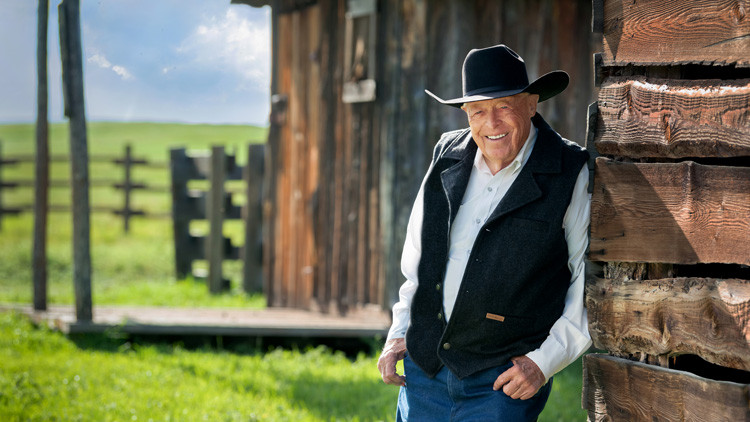
John Scott is a legendary rancher, a TV and movie stuntman and a champion of the Alberta film industry. He has served as a stunt performer or animal wrangler on hundreds of shot-in-Alberta productions. A longtime supporter of the Calgary Stampede, he also runs John Scott Productions, a motion picture lot that has attracted hundreds of film productions to Alberta.
John Scott was born in Calgary, but he spent as much of his childhood as he could on a family ranch in Longview. That ranch has been established even longer than Alberta: John’s grandfather and his 2 brothers established a homestead on the site in 1904 upon emigrating to Canada from the Orkney Islands off the coast of Scotland. John’s father was in the military, and his mother raised John and took care of the ranch, which he operates and lives on to this day.
After graduating from high school, John took on numerous odd jobs, including working for Imperial Oil as part of the crew that took the first drilling rig into the Arctic Circle. He had always loved horses, though, and did some competitive riding during rodeo season. “My life has really revolved around horses,” he says. “Pretty well everything I’ve got I owe to a horse.”
In 1969, word spread through the rodeo community that a big Hollywood Western – Little Big Man, starring Dustin Hoffman, Faye Dunaway and Chief Dan George – would be doing some shooting outside Calgary and needed men with riding experience as extras. They were paying $25 a day, which sounded good to John. Within a few days, John had made enough of an impression to be promoted to the stunt team at quadruple the pay. At a $100 a day, he realized one could make a nice living in the movies.
The problem was that few movies were being filmed in Alberta in the 1970s. There were exceptions, though, and John worked on most of them. There was Prime Cut (John served as Gene Hackman’s photo double), Buffalo Bill and the Indians, Robert Altman’s 1976 revisionist Western starring Paul Newman (John was head horse wrangler for the film’s recreations of Buffalo Bill Cody’s ‘Wild West Show’), and Days of Heaven, Terrence Malick’s 1978 period drama (this involved more horse wrangling, including during a terrifying locust-attack sequence).
John had whiled away many weekend afternoons as a youngster watching Gene Autry and Roy Rogers movies at the Hitchin’ Post movie theatre, but he would never have imagined one day helping to make them. Now, though, such a career seemed like a real possibility, with stunt work looking like the most logical entry point. In 1974, he was 1 of 4 co-founders of Stunts Canada, an organization designed to promote Canadian stunt performers to American producers, and soon after that he headed to Los Angeles in hopes of learning more about how the stunt world operated.
“I was always asking questions,” John says. “Like, when you drive a car off a dock and into the ocean, how do you handle your air when you're underwater? They explained a lot to me, how you take an air tank with you and how you rig wagons and how you rig horses.”
In 1980, the Government of Alberta established the province’s first film commission and tasked it with attracting more film productions. John supported this work, often sitting in on meetings with producers, manning booths at movie trade shows and promoting Alberta as an attractive movie location.
The work began paying off on a larger scale as it continued over the ensuing years. For a 1990 Japanese mega-production called Heaven and Earth, John wrangled around 800 head of horses for a single sequence, making it the largest saddlehorse production ever. That opened the floodgates for a pair of prestigious films that were prime showcases for Alberta as a filming location: Clint Eastwood’s Oscar-winning 1992 Western Unforgiven and 1993’s Legends of the Fall with Brad Pitt and Anthony Hopkins (John was head wrangler on both and also a stuntman on the latter). The success of Legends was especially sweet for John. He and Alberta-based producer Murray Ord had spent four years convincing director Edward Zwick to make the film in Alberta, with many scenes shot on the John Scott Ranch. It won an Oscar for cinematography, which was filled with unforgettable “golden hour” shots of the prairies.
John capitalized on all of this activity by establishing John Scott Productions, a collection of standing sets and a vehicle and prop rental outlet not unlike a classic Hollywood backlot, all situated on his grandfather’s original homestead. “I tried to make it a one-stop shopping centre for a producer to make a Western picture,” John explains. “I figured, if everything's there – the wagons, the cowboys, the set decorating, the props – it makes it that much easier to make the picture. It’s very important to me that it all looks accurate.”
Giving audiences an accurate presentation of the traditional West does more than serve the individual movie. In John’s view, if the horses and the saddles are not portrayed properly, a crucial element of Alberta’s heritage could slip away. He has spent a substantial amount of time digging through libraries and museums and collecting vintage buggies, wagons, household items and horse tack equipment to make sure the films he works on reflect and preserve historical reality. “If these films aren’t made right,” he says, “it can kill Westerns, and Westerns are our forte.”
For 30 years, hundreds of films have made ample use of John Scott’s facilities, with Unforgiven and The Revenant being 2 of the more acclaimed productions to shoot there. In 2023, the John Scott Ranch was 1 of 3 Alberta ranches to share the Location of the Year prize at the Global Production Awards.
John was lured to New Zealand in 1999 for a horse-wrangling job on the set of Peter Jackson’s Lord of the Rings trilogy – a rare case of him working outside Alberta. Thanks in no small part to his lobbying efforts (including a longtime lobbying campaign that resulted in the implementation of the Alberta Film and Tax Credit in 2021), Alberta has a bustling film scene that has injected billions of dollars into the economy and created thousands of direct and indirect jobs.
“It's one of the greatest businesses there is,” John says. “The spinoff of a movie dollar is 5 to 6 dollars. It goes to hotels, lumberyards, candy stores, car rental agencies, porta-potties, propane and fuel. If it's a Western, horseshoers make a lot of money shoeing horses. It's just endless, the jobs that a motion picture can create.”
John currently has 67 official film and television credits as a stunt performer and 51 as an animal wrangler. More than 150 productions have been shot on his ranch. In 2001, in recognition of his contributions to the province’s film industry, John received the David Billington Award from the Alberta Media Production Industries Association.
John supports the cowboy scene away from the movie cameras as well. He is a longtime donor to the Alberta 4H program. In the 1980s, he founded one of Canada’s first steer-riding schools, a program that served as a pipeline for three generations of Calgary Stampede bronc, bareback and bull riders. The annual Calgary Stampede parade might not be possible if not for John’s contributions: every year, he supplies the parade with dozens of horses that have been trained to ignore the noise and chaos of the rowdy crowd. Most spectacularly, for the special “Trail of 2000” Stampede event, he organized a 150-mile procession of 200 bucking horses into downtown Calgary.
All the while, he continues to operate a working ranch, raising cattle, horses and a small herd of bison, including white buffalo. He has three daughters and seven grandchildren.
John received the Alberta Horse Industry Distinguished Service Award in 2007. In 2022, he was inducted into the Canadian Stunt Hall of Fame, the same year he received the Queen Elizabeth II’s Platinum Jubilee Medal (Alberta) for his lifetime of contributions to the province. By this time, he was a legend in the industry, and had received the 2007 Alberta Horse Person of the Year, the 2018 Pioneers of Rodeo Award from the Calgary Stampede and the 2019 National Finals Rodeo’s Gene Autry Award for preservation of Western Heritage. John was recognized with the Top 7 over 70 in 2023 and the prestigious Chester A. Reynold award out of Oklahoma in 2020.
Now in his 80s, John is currently working on three projects at his ranch, including the third seasons of a pair of successful streaming series: Billy the Kid and My Life with the Walter Boys.
“I don’t think anybody enjoys getting older,” he says, “but if you enjoy what you’re doing, that’s half the battle.”