
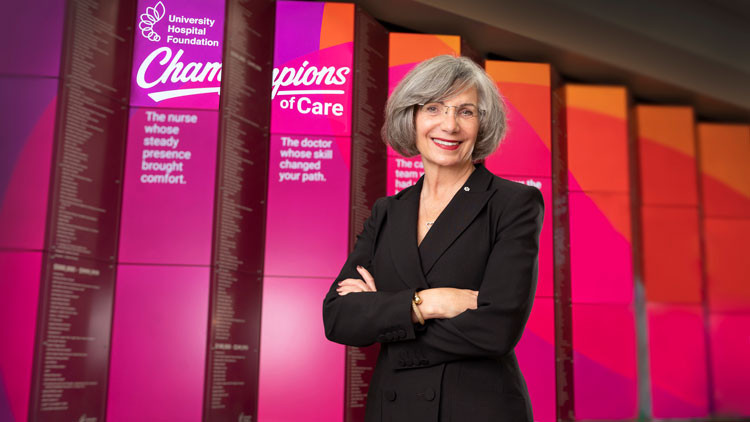
Dr. Jodi Abbott of Edmonton has built a career around seeing what is possible and bringing people together to make it happen. From transforming outcomes for students at NorQuest College to advancing health care innovation through the University Hospital Foundation to helping modernize the governance and judging of international figure skating, Jodi has pursued ambitious goals with exceptional discipline, resolve, and an unwavering belief in people.
Born in Edson, Alberta, in 1964, Jodi Leanne Abbott learned early that achievement required effort. Her mother, Frances, ferried 6 children to their many activities while volunteering with their clubs. Jodi’s father, Stan, ran several small businesses including Edson Real Estate and Gelmici Jewellers. His long days modelled what it meant to create something, put in the work, and make it succeed.
Jodi brought that same discipline to sport. A competitive swimmer and figure skater, she eventually chose skating. Her mother encouraged 16-year-old Jodi to become a figure skating judge as a way of giving back to the sport. It would become a parallel vocation lasting more than 4 decades.
Around the same time, a school guidance counsellor told Jodi she should work for her father because she would not be successful at college or university. Jodi remembers going home devastated.
Her mother had different advice: “Use that to motivate you. You might have to work harder than other students to get what you want, but put in the effort and you’ll succeed.”
Jodi did. She left Edson in 1982, moving to Vancouver for school and later to Calgary, where she earned a degree in psychology from the University of Calgary. She went on to complete a master’s degree and doctorate in educational psychology at the University of Alberta while establishing herself in the non-profit sector.
An early workplace experience reinforced another value central to her leadership. Working for a senior leader in a difficult environment taught Jodi how profoundly respect affects people and organizations. “I believe that respect for all people is important. Respect is neither to be anointed because of position nor is it to be earned. Rather, it is to be given freely as a basic human right.”
That belief has guided a career spent tackling complex systems and finding ways to make them work better.
After leadership roles with Catholic Social Services and the Canadian Diabetes Association Prairies Area, Jodi joined the Government of Alberta in the mid-2000s. She helped develop new physician payment approaches, including Primary Care Networks and Alternate Payment Plans, and her department co-led Alberta’s first public health emergency pandemic plan.
She later held senior roles with Capital Health and Alberta Health Services during one of the largest reorganizations in the province’s health care system. As 11 regional health organizations became one provincial system, Jodi helped develop province-wide approaches to patient safety, infection prevention, and clinical improvement. Before leaving Alberta Health Services in 2010, she had risen to senior vice president of Quality Performance Improvement.
For Jodi, data grounds ambitious ideas. “For me, it has always been about getting results in an informed and authentic way.”
There is something of the athlete in her approach: dream big, do the work, and prove what is possible.
As her professional career developed, Jodi continued her remarkable journey in figure skating. She reached the highest levels of international officiating and became involved in efforts to streamline the development of officials. She also participated in redesigning figure skating’s judging system following the controversy at the 2002 Olympic Winter Games and later served on the Officials Assessment Commission.
Her judging career took her to the Olympic Winter Games in Vancouver in 2010 and Sochi in 2014, as well as numerous World Championships. She continues to contribute through the International Skating Union and has served Skate Canada for decades as an official, trainer, and leader.
In 2010, Jodi brought that same discipline and appetite for change to a new challenge when she became president and CEO of NorQuest College. When she arrived, NorQuest served approximately 6000 learners and faced a confidence problem as much as a growth challenge. “When I went to NorQuest, we were a tiny college. We did a brand study and learned we were considered the school of last resort. We had very poor confidence in ourselves.”
Jodi saw something different. “We don’t need to be that. We can be something more without losing who we are.”
She challenged the college to imagine serving 20,000 students within 10 years. At first, the goal stunned her team. Years later, as enrolment approached the target ahead of schedule, that same team asked whether the goal was ambitious enough.
Under her leadership, NorQuest grew to approximately 20,000 learners while strengthening its identity as an institution serving one of the country’s most diverse student populations. The college expanded partnerships and developed initiatives including the Alberta Indigenous Construction Career Centre, the Edmonton Oilers Community Foundation Hospitality Institute, and new approaches to inclusive learning.
Jodi also led the largest infrastructure transformation in NorQuest’s history. The Singhmar Centre for Learning opened, the existing tower was renewed, and the 1000 Women Childcare Centre was created. They were physical signs of something larger: an institution that had learned to believe in its own potential.
In January 2020, Jodi became president and CEO of the University Hospital Foundation. Once again, she began by asking what the organization could become.
Traditionally, hospital philanthropy focused on equipment, infrastructure and research within hospital walls. Under Jodi’s leadership, the Foundation began looking farther upstream. Its Ignite 2030 strategy broadened its role to include prevention, primary care and innovations intended to improve health before people require acute and specialized care.
The Foundation continues to support innovation at the University of Alberta Hospital, Mazankowski Alberta Heart Institute, Kaye Edmonton Clinic, and University of Alberta while forging partnerships across sectors to improve health outcomes across Alberta.
That ability to convene people has also shaped Jodi’s broader community leadership.
At the request of the City of Edmonton, she helped lead Health City, bringing government, post-secondary institutions, business and investors together around a shared vision for Edmonton as a centre for health innovation. It has since grown into Health Cities, with a province-wide mandate.
From 2017 to 2020, Jodi served as inaugural independent chair of the Edmonton Metropolitan Region Board, where 13 municipalities were required to plan together for the long-term growth of the region.
The municipalities did not always begin with the same priorities. Jodi created conditions in which different perspectives could be heard while building enough trust to reach consensus. Under her leadership, the Board advanced major regional planning initiatives affecting the future prosperity and quality of life of the Edmonton metropolitan region.
It was another version of work Jodi has done throughout her career: entering complex territory, creating a shared purpose and helping people move toward it together.
Jodi’s leadership has been recognized across Canada. She was invested as a Member of the Order of Canada in 2023 and has received the Queen Elizabeth II’s Platinum Jubilee Medal (Alberta) and the Queen Elizabeth II Diamond Jubilee Medal. Twice named one of Canada’s Top 100 Most Powerful Women, she was also recognized as a Woman of Vision and received a Communications and Leadership Award from Toastmasters International District 99. The University of Alberta honoured her as a Distinguished Alumna, while the City of Edmonton recognized her with its Salute to Excellence Citation and Performance Award.
Her achievements in figure skating have earned parallel recognition. Jodi was inducted into the Skate Canada Alberta-Northwest Territories/Nunavut Section Hall of Fame in 2026 and the Sports Officials Canada Officiating Hall of Fame in 2013. She also received Alberta Sports Connection’s Officiating Award of the Year, Skate Canada’s Billie Mitchell Award, and the Fox 40 Kitch MacPherson Award of Excellence.
Recognition has not slowed her involvement. Jodi continues to serve on the International Skating Union’s Elections Committee and as vice-chair of Alberta Innovates. Her previous service has included the Institute of Corporate Directors Edmonton Chapter, Stollery Children’s Hospital Foundation, and Sinneave Family Foundation.
Through the years, Jodi’s understanding of leadership has continued to evolve. Discipline and determination taught her how to pursue ambitious goals. Experience taught her the importance of respect. More recently, her partner, Surjit, has helped deepen another lesson: achievement is rarely an individual accomplishment.
“I don’t believe anybody does anything on their own,” Jodi says. “Being able to be supported and receive support from others is critical. It is about the people you love who need to be there, and you need to be there for them.”
It is a fitting realization for someone whose life’s work has depended upon bringing people together. Whether the challenge is educating thousands more students, transforming health care, building consensus among municipalities, or improving a sport she has loved since childhood, Jodi Abbott begins with a belief that something better is always possible.