
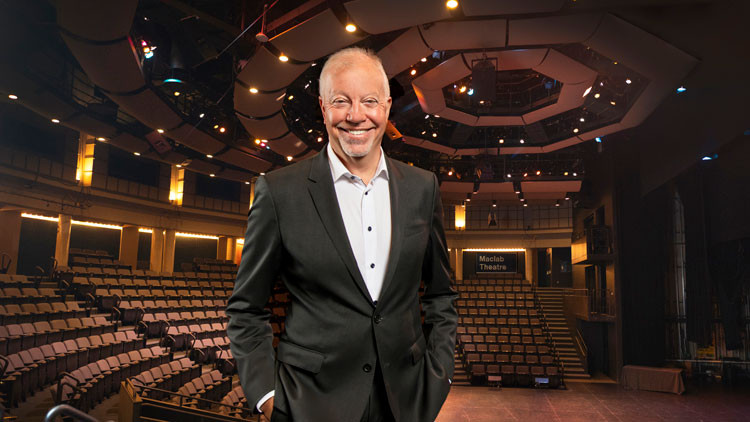
For Bruce Bentley, community has never been something observed from the sidelines. A business leader with a talent for finance, governance and bringing people together, he has spent decades helping organizations navigate change, seize opportunities and emerge stronger. From business and professional sports to the arts, education, health care and civic life, Bruce has repeatedly stepped forward when there was work to be done. His explanation is characteristically simple: “So much of this, to me, has just been showing up.”
David Bruce McEwan Bentley was born in 1958, growing up on Edmonton’s south side in a family where community involvement was an integral part of life. His mother Janet and his father David were active in many civic, not-for-profit, and professional organizations including the University of Alberta, the Edmonton Art Gallery and the Citadel Theatre. “It sounds cliché,” Bruce says of his family’s commitment to community, “but it was just normal to me. I was probably more surprised by people who weren't engaged.”
Some of Bruce’s earliest lessons in leadership came during evening walks with his father. “My dad was tremendous. We would walk the dog at night when I was in junior high and high school, and he would talk about business. I learned so much from him.” Those conversations taught Bruce not only about the challenges business organizations can face, but about making decisions with the broader community in mind.
Good with numbers, Bruce followed his interests to the University of Alberta, graduating with a bachelor of commerce degree in 1980. He began his professional career in Calgary before an opportunity with Bramalea Inc. took him and his wife Carol to Toronto. There, Bruce advanced through increasingly complex financial roles, eventually becoming senior vice-president of Finance and Administration for the company’s Canadian Properties Group.
The experience would prove formative. In the early 1990s, recession and financial pressures pushed Bramalea into the second-largest Companies’ Creditors Arrangement Act filing in Canadian history at the time. Amid the uncertainty, Bruce was heavily involved in the company’s restructuring. It was an education in leading through volatility – one that would serve him throughout the rest of his career.
In 1995, another opportunity brought Bruce, Carol, and their sons Cale and Jase home to Edmonton. Bruce joined Maclab Enterprises as vice-president of Finance and Controller and, in 1998, became president and CEO. For almost 2 decades, he led the company through a period of substantial growth and change. Maclab acquired, developed and managed residential, commercial and hospitality properties across western Canada. Bruce's time at Maclab encompassed cycles of extraordinary growth followed by equally significant downturns. His leadership required not simply identifying opportunities during good economic times but protecting the organization and its people when conditions changed. His approach was grounded in financial discipline, long-term thinking and a willingness to make difficult decisions.
In 2017, following the reorganization of Maclab Enterprises into Maclab Development Group and Second Street Fund, Bruce became chair of the board of each entity. Still in that role today, he continues to provide strategic oversight to the next generation of management leading the two organizations.
His expertise frequently opened the door, but it was his capacity to lead that kept Bruce in the room. “I have usually come into projects because I have both a financial and real estate background,” he says. “But, if there was an opportunity for me to help as a chair or to chair a committee, I tried not to shy away from that.”
That pattern has repeated itself throughout his community life.
His long involvement with Edmonton’s community-owned football team provides a clear example. Beginning in 2006, Bruce served the organization in roles ranging from director and treasurer to board chair and chair of the board of governors. He also represented Edmonton as a governor of the Canadian Football League.
Then, in 2023, the Edmonton Elks confronted perhaps the most consequential challenge in the club’s history. Financial pressures and declining attendance had placed the future of the long-standing community-owned franchise in doubt. Bruce was asked to chair the special committee reviewing the team’s ownership structure. Once again, financial expertise brought him to the problem and leadership helped him navigate it. The committee’s work culminated in the successful transition of the club to private ownership in 2024, providing greater stability for an Edmonton institution Bruce had served for years.
His love of sport extends beyond football. Following the 2001 World Championships in Athletics in Edmonton, surplus funds from the event were placed in a legacy foundation to support the future of Canadian athletics. Bruce joined the Edmonton 2001 Athletics Legacy Foundation board in 2010 and has served as its chair since 2016, helping preserve the benefit of the event for a new generation of athletes.
Education has been another constant in Bruce’s life. He continued his own studies through executive education at Stanford University’s Graduate School of Business and the Institute of Corporate Directors program. At the University of Alberta, he served as president of the Alumni Association and later as a member of the Senate, following a path once taken by his mother. He has also shared his experience through advisory roles with the business faculty at both the University of Alberta and Concordia University of Edmonton.
Bruce was among the civic leaders who sat on the Edmonton Committee to End Homelessness, which later established the Edmonton Homeless Commission. He became involved at a time when homelessness was becoming an increasingly significant issue in Edmonton. Behind it was a simple conviction: we should all have an opportunity to thrive.
“I am a strong believer that you should get involved in something that interests you,” Bruce says. By that measure, his interests have been substantial.
Few projects demonstrate the combination of Bruce’s professional expertise and volunteer leadership as clearly as his work with the Banff Centre for Arts and Creativity. When aging facilities threatened the institution’s ability to meet its future needs, Bruce chaired its Campus Development Committee and helped lead the creation of a comprehensive redevelopment plan. The task demanded more than construction knowledge. Redevelopment within Banff National Park required careful planning, extensive consultation, and consensus among numerous stakeholders. Bruce became a bridge among the people who were needed to make it work. He helped guide the planning and construction process, brought different project teams together and helped move a vision toward implementation.
As a member of the campaign cabinet, he was also part of the effort that raised $130 million to renew the campus. The redevelopment was completed on time and on budget, strengthening an Alberta institution that boasts national and international reach.
Bruce counts his involvement at the Banff Centre for Arts and Creativity, which also included terms as vice chair of the board of governors and on The Banff Centre Foundation board, among his proudest accomplishments.
The same instinct – to leave important institutions stronger – runs through Bruce’s service to Edmonton.
He represented the city on the River Valley Alliance, served on the Edmonton Chamber of Commerce board, and co-chaired the Tourism and Entertainment Cluster of the Greater Edmonton Competitiveness Strategy Initiative. At Fort Edmonton Management Corporation, he helped oversee major capital work that included the Capitol Theatre and the Selkirk Hotel, preserving and reinvigorating places where Edmonton tells its story.
His connection to the arts in Edmonton is equally deep. Bruce now chairs the board of governors of the Citadel Theatre, continuing a family association with the theatre that began with his father. He has supported the Art Gallery of Alberta through the AGA Always initiative and previously served as a director of the Winspear Foundation.
Health care has also benefited from his willingness to contribute. Bruce served on the leadership committee of the Mazankowski Alberta Heart Institute’s Edmonton Strategy Council during the years leading to its opening and early operation. More recently, he was a member of the CapitalCare Foundation Stepping Up Campaign Cabinet for the Gene Zwozdesky Centre at Norwood, a modern continuing care facility created to serve a growing population of Albertans needing specialized and long-term care.
For all his involvement in Edmonton, Bruce believes his years outside the province broadened his view of home. Living in Toronto, travelling and working with people in different parts of North America gave him perspective. “If you could take every kid and send them to Ontario or Quebec or the Maritimes for a month, it would change this country dramatically,” he says. “Moving to Toronto changed my life. It opened my eyes to the depth and breadth of Canada.”
Yet Edmonton drew him back. “I'm a huge supporter of the city and the province,” he says. “I believe the opportunities in Alberta are head and shoulders above anywhere else in the country.”
For Bruce, achievement has never been measured by responsibility or profile alone. It can be found in institutions strengthened, difficult decisions made, people brought together and communities made better. It starts with being interested enough to care – and willing enough to show up.