Overview
The bushy-tailed wood rat, commonly called referred to as pack rat, is the only native pack rat species in Canada. They prefer mountainous or rocky terrain and range from the foothills into the mountains in Alberta.
Under the Agricultural Pests Act, bushy-tailed wood rats are classified as a nuisance species. This means landowners have the right to control them on their property but are not required to implement control measures.
Identification
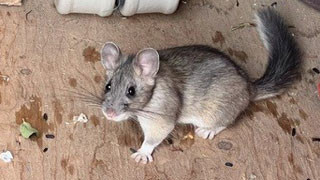
Bushy-tailed wood rats have a thick coat that is silver-grey to dark grey to brown on their back and sides and white or light bluff on the belly, throat, chin and feet. Their eyes are large and black with ears large, rounded and fur covered. Tails are bushy like a squirrel and are as long as the body.
Reproduction
Breeding occurs during spring and summer months and is closely tied with spring green-up. Gestation is 30 days with an average litter size 3 to 4 pups. Around 30% to 60% of females will produce a second litter, in warmer climates females can have up to 3 litters per year. Lifespan is a maximum of 3 years in the wild.
Behaviour
Bushy-tailed wood rats are typically solitary, maintaining individual dens except during mating and when females are raising their young. Adults establish a home range through scent marking rarely leave it once it has been established. They are territorial with males defending their home range from other males and attempting to overlap the home ranges of several females.
They are active throughout the year and nocturnal.
The nickname pack rat was earned due to their persistent gathering of assorted items at their den site. They collect items from their environment such as rocks and sticks but will collect shiny items such as jewelry or clothing items if available.
Control
If Bushy-tailed wood rats are present in a structure, exclusion methods can be an effective method of eliminating damage. All entrances accessible to the building must be closed including at the attic level as they are agile climbers. Inspection should be done for cracks and openings around windows, doors, foundations and pipes.
Trapping is an effective form of control as they show little to no fear of new objects in their environment. Large snap traps that are rat sized baited with dried fruit, nut meats, oatmeal or biscuits will attract them. Bait should be wedged into or tied to the trip plate to ensure the rodent does not remove the bait without setting the trap off.
There are no products registered in Canada for chemical control of this species.