Notifications

Government mail service may be affected by the Canada Post labour disruption. Learn about how critical government mail will be handled.

Avian influenza in wild birds

Ongoing surveillance for avian influenza virus in wild birds, which can spread to domestic birds and poultry.

Overview

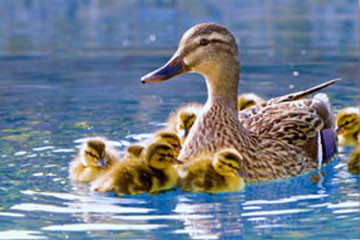
mother duck with ducklings

Avian influenza viruses are common infections in wild birds, primarily waterfowl. Many strains of avian influenza viruses occur naturally in wild birds around the world, particularly:

  • ducks
  • geese
  • shorebirds

When migrating waterfowl and shorebirds pass through Alberta from the north, they can share their viruses with local wild birds which may not have the same level of immunity.

The Alberta government conducts ongoing surveillance of the virus in wild birds and reports results to the national surveillance program.

Traditionally, avian influenza viruses did not cause disease in wild species but can spread and impact domestic poultry, including ducks, chickens and turkeys. These viruses are a significant concern for poultry producers and potentially pork producers.

While we see cases of avian influenza confirmed in wild birds every year, this fall, we are seeing an increase in the number of sick and dead waterfowl with avian influenza. The virus poses very little threat to humans and is different than the human influenza viruses, but the primary risk is to farmed poultry.

Ongoing surveillance

October 2025

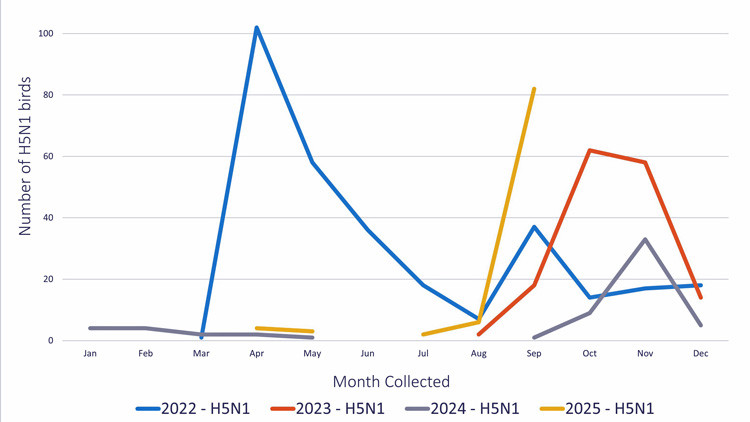
After a lull of cases in wild birds in 2024 and spring 2025, the number of cases of avian influenza has risen across the province. As arctic-breeding waterfowl migrated southwards in September and October, reports of sick or dead wild birds steadily increased across the province.

Most cases involved sick or dead Canada geese, as well as a few owls, hawks, falcons, and skunks. In sick birds, the classic signs of avian influenza were seen and include head tremor, cloudy eyes, weak neck, lethargy, and staggering or swimming in circles. Highly pathogenic North American H5N1 was confirmed in many of the wild birds that were submitted for testing.

Similar situations occurred this fall in most provinces and many northern states as migrating waterfowl moved out of the north across Canada and into United States. As they continue to migrate, cases are expected to go down.

Image 1. Monthly H5N1 cases in wild birds from March 1, 2022 to October 1, 2025.

Chart showing Monthly distribution of H5N1 cases in wild birds from 2022 to 2025
Source: Government of Alberta

Surveillance history

  • August 2025

    After 2022-23, avian influenza mortality in wild birds and mammals in Alberta significantly declined. The genetic makeup of the H5N1 changed into something less pathogenic and wild waterfowl and shorebirds developed a protective immunity that limits the risk of fatal infections. Many wild waterfowl now carry H5N1 and can potentially pass it on to stressed individuals or young waterfowl that have not developed immunity, particularly during spring and fall migration.

    A few wild birds, sick or dead with H5N1, are detected each spring and fall. Peregrine falcons may be at particular risk when they consume infected wild ducks. Similarly, a few skunks that scavenge on infected waterfowl also may succumb to the virus.

  • November 2023

    H5 avian influenza was detected in wild birds in Alberta in mid-August 2023. Starting in mid-September, multiple cases were identified across Alberta, primarily in Canada geese. As in 2022, infected skunks also were detected. Related outbreaks were seen in domestic poultry.

    While considerably less than the mortality seen in 2022, the fall mortality is an indication that a pathogenic form of the virus is still present in wild waterfowl and poses ongoing risk to other wild and domestic species.

  • June 2023

    Despite ongoing surveillance, mortality associated with H5 avian influenza was not detected in wild birds or mammals in Alberta this spring. It appears to be a ‘normal’ year for this virus.

  • January 2023

    Mortality associated with H5 avian influenza in Canada geese and a few dabbling ducks continues on partially frozen rivers, reservoirs and ponds in southern Alberta. Numbers of dead birds range into the 100s at most locations, although the mortality is primarily in geese and not ducks. 

    In particular, fresh and frozen dead geese can be seen on the ice near open areas of the Oldman and South Saskatchewan rivers, with concentrations near Lethbridge, Coaldale, Taber, Bow Island, and Medicine Hat. Avian influenza virus has been confirmed at all of these locations.

    On a global scale, the highly pathogenic avian influenza (HPAI) H5N1 virus is spreading southwards in wild waterfowl into Central and South America, with associated spillover into domestic birds. Ongoing HPAI mortality also is occurring in wild birds and domestic poultry in parts of Europe, Asia and Africa.

  • December 2022

    In various open water areas (that is, ice-free) on ponds and rivers in southern Alberta, overwintering waterfowl, primarily Canada geese and mallard ducks, are experiencing mortality. H5 avian influenza has been confirmed in these outbreaks.

  • November 2022

    Through 2022, an outbreak of highly pathogenic avian influenza (HPAI), an H5N1 strain, occurred in wild and domestic birds across Canada and USA. In Alberta, the outbreak began in early April 2022. As spring migrating waterfowl moved north through the province, there was local mortality of many snow geese and a few Canada geese, as well as various sick or dead raptors and waterfowl. The virus was present over a broad area of southern, central and eastern Alberta, and eventually the northwest.

    In mid-May the outbreak appeared to decline, as evidenced by fewer sick or dead waterfowl or raptors. Through June and July local mortality events at various cormorant and grebe colonies signalled a localized secondary outbreak. However, August passed without detection of the virus in any sick or dead wild birds tested.

    Public reports of sick or dead waterfowl picked up in mid-September and H5 avian influenza virus was again detected in a few individual geese. For the first time in this outbreak we also detected H5 in wild ducks, including many live mallards. However, the mortality associated with fall migrating birds was considerably less than that seen during spring migration in April and May.

    By mid November few migratory waterfowl remain in the province and the number of sick or dead wild birds is low again. We have reverted to our standard ongoing interest in receiving reports of clusters of unusual mortality or clinically neurologic wild birds, including songbirds.

    Read the Avian Influenza outbreak in wild birds 2022: Final report of the provincial wild avian influenza surveillance program from April 1 to October 31, 2022.

    Impact on local bird populations

    Red-tailed hawks, great horned owls (adults and chicks), and crows were hit hard by this strain of avian influenza, and died after scavenging on infected dead geese. Similarly, adult raptors fed infected material to their nestlings which subsequently fell ill and died. Alberta has a growing list of presumptive and confirmed HPAI in species of waterfowl and scavenging birds.

    Starting in mid-June, sick and dead grebes and cormorants were found in association with some of their nesting colonies. The H5 avian influenza virus was detected in eared grebes, western grebes and double-crested cormorants submitted for testing.

    In late summer and fall, a few individual wild birds, along with a few skunks, tested positive for H5 AIV, but not nearly the numbers seen in April and May.

    Testing and reporting

    The AIV outbreak in wild species is largely over for 2022. Ongoing avian influenza surveillance returns to investigating clusters or groups of sick or dead waterfowl or raptors (hawks, owls, falcons), and testing as appropriate. Such situations can be reported toll-free at 310-0000.

    Note, small birds (songbirds) that use bird feeders and bird baths were not involved in the influenza outbreak.

  • Mammal surveillance

    In conjunction with the provincial avian influenza surveillance program, strange neurologic behaviour and mortality was detected in striped skunks in spring 2022. The timing and distribution of these cases overlapped the area where HPAI H5N1 was documented in wild birds.

    Through April and May 2022 over 80 reports of dead skunks in east central Alberta were received. Skunks submitted for diagnostic examination were negative for rabies but were positive for H5 strains of avian influenza and confirmed as infected with HPAI (H5N1). The investigation of the mortality event continued through the summer.

    In addition to striped skunks, Alberta disease surveillance detected H5 avian influenza in a few young foxes with neurologic behaviour. A number of provinces and states also confirmed HPAI in young foxes with strange neurologic behaviour. Young foxes have incomplete immune systems and may be less able to fight off the virus.

    Alberta also detected H5N1 avian influenza in one black bear.

Previous outbreaks

In Canada, avian influenza is a national reportable disease when it occurs in poultry. Outbreaks in domestic birds occur now and again, as happened in British Columbia and Ontario in 2015 and Nova Scotia and Newfoundland and Labrador in 2021-22. For more information, see:

Influenza viruses constantly change and resort their genetic material. Highly pathogenic (disease-causing) strains in poultry generally do not occur in wild birds.

  • 2021 to 2022

    In late 2021, a highly pathogenic avian influenza – H5N1 North American strain – was detected in Canada in domestic and wild birds. Significant mortality was documented in domestic poultry in some maritime provinces.

    Following increased surveillance, a similar H5N1 was detected in a few wild waterfowl in the same local areas. Federal and provincial disease control programs were activated to control the outbreaks in domestic birds.

  • 2015 to 2017

    A highly pathogenic strain of avian influenza was found in North America in a few wild birds in 2015, but seemed to disappear in 2016-17.

    In spring and early summer 2015, unprecedented outbreaks of highly pathogenic avian influenza in domestic poultry occurred in parts of Canada and the USA. At the same time, the highly pathogenic strains were found in wild waterfowl in various US locations. It was apparent that the suite of avian influenza viruses in wild birds changed and that Eurasian high path influenza viruses had arrived in North America.

    In response to these findings national, state, and provincial agriculture and wildlife agencies implemented enhanced surveillance programs in appropriate wild and domestic birds. They also worked with affected stakeholders to improve understanding of the risks and to encourage high quality biosecurity in regards to poultry.

    Significant numbers of poultry died or were culled in attempts to control the outbreaks. Mortality in the wild appeared to be limited to a few raptors that likely ate infected waterfowl.

    Enhanced surveillance of wild birds across North America detected a relatively small number of wild birds with the highly pathogenic virus strain. No mortality events in wild birds were detected.

  • 2006

    In 2006, a highly pathogenic strain found in domestic birds in Asia appeared in wild birds across Europe, Asia and Africa.

    Representatives from the Government of Alberta wildlife and agriculture departments established a provincial Avian Influenza Planning Committee and developed a surveillance program in wild birds as follows:

    • Monitoring wild bird populations to include:
      • testing dead waterfowl, particularly swans and raptors
      • investigating reports of unusual bird mortality, and testing where appropriate
      • collecting tissues from crows and magpies that were negative for West Nile virus and providing them to the National Avian Influenza Surveillance Program
      • providing Alberta-specific information on our wildlife disease web pages
    • A report on the 2006 surveillance efforts was completed:
      • a total of 83 found-dead birds was tested
      • only 3 birds (2 gulls, 1 mallard) were found to have low pathogenic strains of avian influenza
      • no evidence was found of the highly pathogenic H5N1 strain, which caused mortality in parts of Asia, Europe and Africa

    Read the report: Surveillance for High Pathogenic Avian Influenza in Dead Wild Birds in Alberta, 2006

    There was no evidence that the highly pathogenic strain occurred in North American wild birds. However, mixing of Eurasian and North American birds in Arctic breeding areas could potentially introduce this strain to North America with migrating birds in late summer and fall.

  • Avian influenza surveillance

    The Alberta government has ongoing surveillance of wild birds in conjunction with national surveillance programs.

    The key points of the surveillance efforts place a focus on dead birds submitted for disease investigation. Bird species primarily assessed include:

    • waterfowl (ducks, geese, swans)
    • shorebirds (gulls, terns)
    • birds of prey (hawks, eagles, owls)

    More details are in the "More information" section below.

    National wild bird surveillance data is available from:

More information

  • How influenza viruses are named

    All viruses contain genetic material wrapped in a protein coat. Influenza viruses are separated into types based on 2 of the proteins in this coat: hemagglutinin (H) and neuraminidase (N). 

    Strains of influenza viruses are named according to the type of H and N proteins that they contain as well as where they occur. For example, the strain of greatest current concern around the world is known as Eurasian H5N1. This virus recently morphed into a distinct North American H5N1.

    In addition, the mortality that strains cause in chickens is an indication of "high" or "low" pathogenicity (often shortened to high path or low path). Eurasian H5N1 is highly pathogenic to poultry. However, there are other strains of H5N1 that are not high path.

  • Avian influenza in Eurasia

    Eurasian high path H5N1 avian influenza was first described in Hong Kong in 1996. It then spread in poultry and domestic waterfowl populations throughout Southeast Asia. In 2005, the virus spread to wild, migratory waterfowl, leading to outbreaks in waterfowl in China and Mongolia. The virus is known to occur in several other countries in Central Asia, Eastern Europe, Western Europe, and Africa. By 2025, the high path forms of H5N1 are present in wild birds around the world.

    High path H5N1 spread initially via the legal and illegal international trade in domestic birds and bird-related products. However, once it became established in the wild, it spread primarily in migratory waterfowl. Millions of domestic birds were culled in an attempt to restrict the spread of the virus. A limited number of people associated with poultry also contracted H5N1, some of whom died. It is important to note this strain does not spread efficiently from human to human and to date no one has been infected directly from a wild bird.

  • Avian influenza in North America

    Avian influenza viruses have been monitored in North America for over 50 years, including surveillance sites in Alberta. These studies show that:

    • low pathogenic strains are common in North American waterfowl
    • high pathogenic strains were isolated from wild birds in North America in 2014, 2015, and 2022
    • the most recent HPAI H5N1 is common in wild ducks that migrate through Alberta
    • the viruses are more frequent in juvenile birds than adults and frequency differs among species
    • strain frequency is variable from year-to-year, month to month, and even week to week
  • How highly pathogenic H5N1 came to North America

    It is likely that mixing of Eurasian and North American waterfowl in arctic breeding areas was the source of high pathogenic Eurasian strains in North America. This suggests there was limited sharing of influenza virus between the continents but once introduced, the virus spread rapidly across Canada and the US.

    Further mixing of the Eurasian strains with resident North American strains gave rise to a new high path North American H5N1. Canadian and US governments maintain active monitoring programs to look for all high pathogenic strains of avian influenza in wild or domestic birds.

  • Finding a dead wild bird

    Most bird species are not affected by avian influenza (for example all songbirds, woodpeckers, and blackbirds). Therefore, effective surveillance focuses on species most likely to be infected, and even then it is not necessary to test all individuals of these species. Alberta's ongoing surveillance of wild birds primarily uses groups of dead waterfowl (particularly ducks, geese, and swans), gulls, corvids (magpies, crows, ravens) and raptors (hawks, owls, eagles). 

    • Call toll-free 310-0000 to report dead waterfowl or raptors.

    As a general guideline, members of the public should avoid direct handling live or dead wild birds. If moving sick or dead birds, wear disposable gloves, place a plastic bag over your hand before picking up the dead bird, or shuffle the dead bird into a box or container without touching it (for example, use a stick to move the bird).

    Wash your hands with soap and water, and disinfect using alcohol, diluted bleach, or commercial disinfectants any surface that was in contact with dead birds.

  • Hunting waterfowl

    Healthy flying waterfowl are unlikely to be infected with avian influenzas that pose any risk to hunters. To date, no person has been infected with avian influenza directly from wild birds.

    Basic hygiene including washing hands with soap and water, wearing latex gloves, and disinfecting work surfaces after processing wild birds are added precautions that further limit any potential risk. A facemask and eye protection also can be used to reduce any potential risk. Of course, normal hunting and gun safety precautions should be followed at all times.

  • What is happening with avian influenza

    All H5 and H7 subtypes of avian influenza must be reported to the Canadian Food Inspection Agency. If subsequent tests identify high path strains in wild birds, the public as well as provincial, territorial, and federal agriculture, health and wildlife agencies are notified through this web page.

    Visit these sites to find out what follow-up actions are underway by:

    The Alberta government continually monitors mortality in wild waterfowl, particularly the species and in the geographic area in which high path strains are anticipated.

  • No culling of wild birds

    Culling of wild birds is inefficient and ineffective in reducing the health risks to poultry or any secondary potential health risks to humans.

  • Avian influenza virus compared to pandemic influenza

    Pandemic strains of influenza are so named because they readily spread among humans and often cause fatal infections. The World Health Organization and other health agencies are concerned that current strains of avian influenza could potentially give rise to a human pandemic strain that passes freely from person to person and thus could pose serious risk to human populations. 

    Note, the source of current pandemic strains occurs within people and not within wild birds.