Competitive tax system
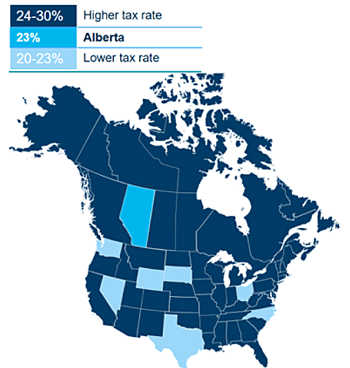
Alberta offers one of North America’s most competitive fiscal environments with a corporate tax rate of 8%, the lowest in Canada. This structure, free of provincial sales tax, payroll tax and provincial capital tax, means more capital stays in your business to drive growth.
Alberta has:
- 8% provincial corporate income tax rate
- no provincial sales tax
- no provincial capital taxes
- no payroll taxes
- no health premiums
Learn more about Alberta’s competitive tax system
Global connectivity
From pacific ports to railway access all the way to Mexico, Alberta has the infrastructure to connect your business to the world.
Faster access to Asia
Alberta is the closest inland province to Canada’s deep-water pacific ports in Vancouver and Prince Rupert.
Shipping from Prince Rupert to Shanghai is 36 hours faster than from Vancouver and over 68 hours faster than from Los Angeles.
One rail line, 3 countries
Alberta is a major hub for the Canadian Pacific Kansas City (CPKC) network, the only railroad that connects Canada, the U.S. and Mexico with a single, continuous line.
Combined with CN Rail, Alberta has direct rail access to every major industrial center in North America.
Major airports
Alberta’s 2 international airports are hubs for global cargo and business travel:
- Calgary (YYC): More than 80 global destinations the primary air cargo gateway for Western Canada.
- Edmonton (YEG): More than 50 global destinations.
Reach 27 million customers in 24 hours
With the CUSMA (USMCA) trade agreement and Alberta’s highway network, your business can reach a massive consumer base almost instantly.
A 1-day trucking radius from Alberta can reach 27 million consumers in the Pacific Northwest and U.S. Midwest while north-south highway links provide a straight line to the U.S. border.
Free trade agreements
Canada has 15 free trade agreements that give Alberta access to 51 foreign countries and 1.5 billion potential consumers including:
- Canada-European Union Comprehensive Economic and Trade Agreement
- Comprehensive and Progressive Agreement for Trans-Pacific Partnership
- Canada-United States-Mexico Agreement (CUSMA)
Talent pool
Alberta boasts a diverse, young, highly-educated and growing workforce. Two of the top 10 universities in Canada are in Alberta – the University of Alberta and the University of Calgary. These 2 universities, along with many other excellent post-secondary institutions across Alberta, attract thousands of students from around the world each year.
As a result, Alberta has one of the most highly educated workforces in Canada, with half its population aged 25 to 64 having a post-secondary education. With a skilled and resilient labour force supported with targeted attraction, training and upskilling programs, Alberta ensures businesses have the talent they need to grow and diversify.
- Learn more at the Alberta Economic Dashboard
Research and development
As of March 2026, Alberta has over 22 research and innovation facilities in areas like plant based-food development and formulation, crops, cereals, agronomy, biomaterials and food safety including:
- Alberta Food Centre – supports food and beverage companies through product development, interim processing and leasable suites, allowing businesses to scale production and test global markets before investing in manufacturing facilities.
- Alberta Machine Intelligence Institute – Canada’s premier centre for bridging world-leading artificial intelligence for adoption in the industry.
- Bio Processing Innovation Centre (BPIC) – provides essential development and scale-up support for bio-industrial processors. The centre has a specialized suite of facilities, lab and pilot-scale production equipment and technical expertise to help companies de-risk their innovations and accelerate their path to commercialization.
- InnoTech Alberta – one of the most versatile fermentation pilot plants in North America and a bridge between laboratory-scale research and full-scale commercial production. With over 30 years of expertise, the facility specializes in developing, optimizing and scaling biological processes for a wide range of industries including food and feed ingredients, biopesticides and probiotics.
- InnoTech Alberta’s decortication facility in Vegreville is a state-of-the-art 13,000 ft2 pilot plant designed to bridge the gap between hemp cultivation and commercial manufacturing. Processing industrial hemp straw into high-purity bast fibre and hurd at a rate of 1 tonne per hour, the facility develops sustainable bioproducts like hempcrete, textiles and automotive composites.
- Olds College Smart Farm – commercial-scale applied research venue to accelerate agtech and agri-food development farming operations aimed at improving productivity and sustainability.
Agri-processing ecosystem
Alberta’s abundance of arable land and well-established primary production industry have positioned its agriculture and agri-food sector as one of the strongest in North America. Alberta has 41,505 farms covering a massive 49.2 million acres, with an average farm size of 1,184 acres. Alberta is Western Canada’s leading food processing destination with a $25.6 billion food processing industry, the largest in the region by sales.
Inputs
Alberta is the largest cattle-producing province in Canada with about 5.1 million head as of January 1, 2025. At that time, there were also 1.54 million hogs and 170,100 sheep in the province.
Meat product manufacturing generates $13.1 billion annually and Alberta is Canada's largest cattle-producing province with 43% of the national herd. Alberta's native prairie grasslands provide excellent water sources and a favourable climate for livestock production.
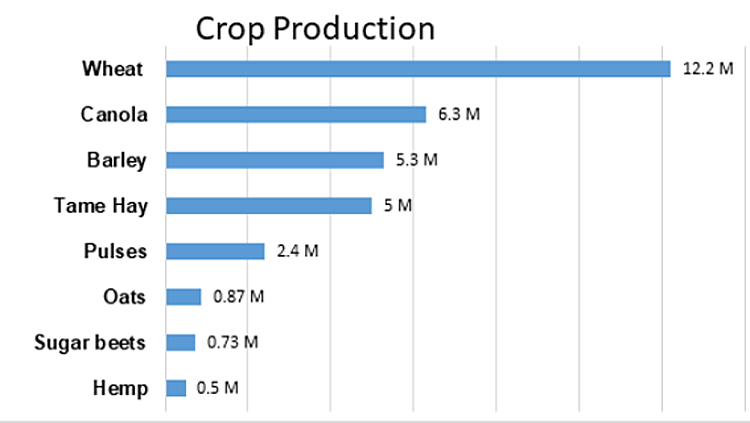
In 2024, Alberta produced 36.4 million metric tonnes of crops, 28.2% of Canada’s production.
Exports
Alberta has an international reputation as a reliable source of agriculture and food products. Major exports include wheat, beef, canola seed, live cattle, crude canola oil and pork.
In 2025, Alberta exported $12.4 billion in agri-food products with value-added processed goods reaching $9.4 billion. That same year, Alberta exported $8.2 billion in primary products to major markets including the United States, China, Japan, Mexico and India.
Figure 1. Alberta Top Crop Production – Million Tonnes (2024)
Source: Statistics Canada
Water and irrigation
Alberta has the largest irrigated area in Canada with nearly 680,000 hectares of irrigated land. More than 80% of this area is located in 11 irrigation districts. Within Alberta's irrigation districts, there are more than 55 reservoirs and approximately 8,000 km of conveyance works, including canals and pipeline which carry nearly 2 billion m3 of water per year.
Alberta partnered with the Canada Infrastructure Bank (CIB) and 9 irrigation districts to invest a total of nearly $933 million to modernize our irrigation infrastructure.
Alberta’s funding opportunities
The Sustainable Canadian Agricultural Partnership is a five-year, $3.5 billion investment by Canada’s federal, provincial and territorial governments. Through this, Alberta’s value-added agricultural processors can benefit from three cost-shared grant programs to grow and diversify.
The Emerging Opportunities Grant Program supports up to $2 million for innovative, high-impact projects.
The Value-Added Program supports up to $250,000 for projects that grow sales, production capacity and expand market opportunities. There are two streams for this program, one up to a maximum up $50,000 and the other with a maximum grant of $250,000.
The On-Farm Value-Added Program supports primary producers in adding value to their agricultural products to grow sales, expand production capacity, explore market opportunities and create jobs in Alberta.
The Growing Greenhouses Program supports up to $4 million for year-round availability of locally-grown food by accelerating growth in Alberta’s controlled environment agriculture sector.
- Learn more about the Sustainable Canadian Agricultural Partnership in Alberta.
The Agri-Processing Investment Tax Credit is a 12% non-refundable tax credit against eligible capital expenditures for corporations and registered partnerships investing $10 million or more to build or expand agri-processing facilities in Alberta.
- Learn more about the Alberta Agri-Processing Investment Tax Credit
Funding for research and development
Research and development is essential for businesses to remain competitive and drive innovation. Agriculture Financial Services (AFSC) provides Alberta’s farmers and agribusinesses with loans, crop insurance and farm income stabilization. AFSC has been a partner in the industry for over 80 years.
Alberta Innovates supports innovation in Alberta through grant funding, coaching, community development and capital facilitation to help Alberta businesses commercialize new technology and grow the province’s economy.
Result Driven Agriculture Research (RDAR) enables Alberta producers to determine and lead agriculture research. RDAR collaborates with scientists and researchers to tap into talents and fund ideas generated by innovators to push the boundaries of Alberta’s potent.
To encourage research and development investment, the federal government offers financial support that helps offset the costs and risks associated with developing new technologies and improving existing products and processes. Scientific Research and Experimental Development (SR&ED) provides tax credits and refunds for expenditures on eligible research and development activities. Your business may earn the credit at a basic rate of 15%. Some corporations may claim an investment tax credit at the enhanced rate of 35%.