The federal Pesticides Regulatory Directorate approved the emergency use of 2% liquid strychnine for Richardson’s ground squirrel control from March 30, 2026 to November 1, 2027. Access mandatory training for strychnine use now.
Overview
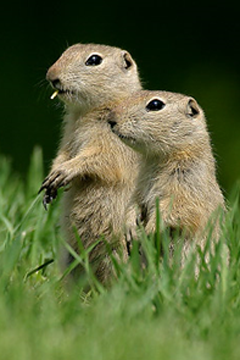
The Richardson’s ground squirrel, commonly called a 'gopher', is a burrowing rodent found across most of Alberta’s prairie and parkland regions.
Richardson’s ground squirrels play an important role in the province’s ecosystem and is a major food source for a variety of predatory birds, mammals and reptiles. While their population numbers can fluctuate from year to year, their population is currently considered stable.
Under the Agricultural Pests Act, Richardson’s ground squirrels are classified as a nuisance species. This means landowners have the right to control them on their property but are not required to implement control measures.
Rodent damage
Damage caused by Richardson’s ground squirrels can range from a minor inconvenience for some landowners to significant economic losses for others. The most common forms of damage include reduced yield from plant trampling and direct crop loss from feeding.
Beyond causing crop damage, Richardson’s ground squirrel burrows pose serious risks to both farm equipment and livestock. Their extensive tunnel systems can lead to equipment malfunctions, unexpected downtime and costly repairs. These hidden holes create dangerous conditions in pastures, increasing the likelihood of leg injuries with livestock.
About the rodent
Integrated pest management model
The greatest integrated pest management benefit occurs when several techniques or strategies are used together and on a continuous basis. The model is designed to produce long term, sustainable management of Richardson’s ground squirrels while minimizing environmental impacts.
Once the decision to use strychnine has been made, applicators should no longer encourage biological controls. Encouraging predation could result in secondary poisoning of non-target species. Users should avoid any practices that could attract raptors or other species to treated areas and must follow all label directions to minimize risks to birds and other animals.
Monitoring and assessment
- Conduct regular surveys in spring and early summer to identify active burrows and estimate population densities.
- Monitor signs of damage to crops, pastures and infrastructure.
- Keep records of activity, predator presence and the effectiveness of control measures.
- Regularly monitor and dispose of Richardson’s ground squirrel and non-targeted species carcasses.
Cultural controls
- Modify habitat to make it less favorable.
- Promote tall vegetation (over 15 cm)
- Retain vegetation around watercourses, fence lines and sloughs to support predator habitats.
- Manage grazing practices to discourage colony establishment.
Biological controls
- Encourage natural predation.
- Install raptor platforms and nest boxes.
- Preserve habitat for ground predators.
Mechanical controls
- Use burrow disruption tools (plowing or cultivating).
- Trapping or shooting.
Chemical controls
- Rodenticides.
- Target chemical use during early spring when Richardson’s ground squirrels emerge and before vegetation fully greens will increase bait uptake.
Evaluation and adaptation
- Regularly assess the success of your control measures.
- Adjust tactics based on outcomes and environmental changes.
- Emphasize long-term prevention over reactive treatments.
Cultural and biological controls
Cultural and biological controls are effective strategies for managing Richardson’s ground squirrel populations.
Richardson’s ground squirrels are prey for a wide range of predators including coyotes, foxes, badgers, weasels and various birds such as owls, hawks, crows and ravens. Predation plays a significant role in natural population control. Enhancing habitats to support these natural predators can help reduce Richardson’s ground squirrel numbers.
Maintaining isolated vegetation patches, promoting plant growth near watercourses and fence lines and installing nesting platforms for raptors can all encourage predator presence. Tall vegetation (over 15 cm) has been shown to deter Richardson’s ground squirrels as they prefer open fields, making dense vegetation another useful tool in slowing or preventing colony expansion.
Raptor nesting platform

Credit: James Tansey and Faith Hillsden
Raptor nesting platforms are an effective, natural tool for managing Richardson’s ground squirrel populations across Alberta’s prairie landscapes. By encouraging natural predators such as Ferruginous Hawks, Red-tailed Hawks and Swainson’s Hawks to nest and hunt in agricultural areas, these elevated platforms help reduce reliance on rodenticides by promoting natural predation.
A single hawk pair can consume between 300 to 500 Richardson’s ground squirrels per breeding season. Platforms are typically installed in open, treeless areas and should be spaced several kilometres apart to minimize territorial conflicts among raptors.
Table 1. Recommended component measurements for a raptor nesting platform.
| Component | Measurement |
|---|---|
| Wooden post or tree | 18 to 20 feet above ground, 5 feet under ground |
| Bird nest platform | 2 feet by 2 feet |
Kestrel nesting box
Credit: James Tansey and Faith Hillsden
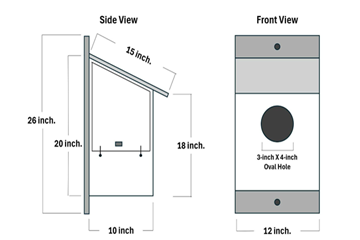
Installing kestrel nesting boxes is a sustainable approach to controlling Richardson’s ground squirrels. American Kestrels are the smallest North American falcons and active daytime hunters that sometimes prey on Richardson’s ground squirrels, making them an effective part of a natural management strategy.
Kestrels pose no threat to livestock or pets and require only open habitat and a suitable nest box to thrive. Encouraging kestrels to nest on your property not only reduces the need for chemical control methods but also supports sustainable farm management.
Table 2. Recommended component measurements for a kestrel nesting box.
| Component | Measurement |
|---|---|
| Back mounting panel height | 26 inches |
| Back panel height | 20 inches |
| Front panel height | 18 inches |
| Box depth (floor) | 10 inches |
| Roof overhang (front) | 15 inches |
| Box width | 12 inches |
| Entering hole | 3 inches wide by 4 inches tall |
Lethal controls and timing
Timing is critical to achieve long-term reductions in Richardson’s ground squirrel populations using lethal methods.
- Implement control in early spring between March and April, just before vegetation begins to turn green.
- Don't bait at the very first signs of activity. Adult males typically emerge from hibernation 2 weeks before the females.
Learn more about the best time to implement lethal controls.
Strychnine access
The federal Pesticides Regulatory Directorate (formerly known as the Pest Management Regulatory Agency) approved the emergency use of 2% liquid strychnine to control Richardson’s ground squirrels from March 30, 2026 to November 1, 2027.
Raw strychnine is harvested overseas and then shipped to Canada. Once received, 2% liquid strychnine is manufactured in Canada and is expected to be available by late May to early June.
Strychnine cannot be sold or used in urban areas and may not be used on acreages.
Farmers across the prairies experience significant gopher damage to crops, hay and pasture. Crop losses increased, insurance claims went up and other control options were not effective during high infestations. Strychnine will give prairie farmers an important tool for gopher control and encourage responsible use.
Precautions
- When using lethal control methods for Richardson’s ground squirrels it is important to follow all label directions to ensure safe and effective use.
- Use only registered products and apply them in a way that minimizes risk to non-target species.
- Always wear protective gear when handling toxic substances and avoid applying treatments during periods of high wind or rain to prevent drift or runoff.
- Regularly inspect treated areas and properly dispose of any carcasses to prevent secondary poisoning of scavengers.
- All toxicants are potentially dangerous and should be handled with the utmost care to avoid accidental poisoning.
- Landowners must post signs at all treatment sites.
- Signs are available from your municipality.
- Be aware of species at risk in your area. Get more information on species are risk:
Species at Risk
Strychnine is a toxic poison that targets Richardson’s squirrels, but it can harm other animals. Animals can be poisoned by bait or eat poisoned squirrels, including species at risk that may be on or move through your property.
Learn more about species at risk in the areas approved for Strychnine application:
- Species at risk and strychnine use: Know who’s nearby before you apply
- Species at risk in areas approved for Strychnine application
Contact us to discuss species at risk you may find on your property. Some species at risk can be difficult to identify.
We recommend taking photos before disposal and contacting Fish and Wildlife staff in your region.
Report non-compliance
All suspected non-compliance with regards to 2% liquid strychnine, or pesticides in general, including use, handling, transport, sales, distribution, application and storage should be reported.
This also includes adverse effects such as impacts to human health, animals or the environment.
For non-target mortality such as multiple carcass events, evidence of secondary poisoning, carcass findings near public areas.
Contact Health Canada’s Pesticide Regulatory Directorate via the Voluntary Incident Reporting.